We have created the Integrated Website Management System for the branches of the Silesian Water Volunteer Rescue Service (Śląskie WOPR)!
For decades, the lifeguards of the Silesian Water Volunteer Rescue Service (Śląskie WOPR) have been watching over the safety of people enjoying time by the water. They train new generations of lifeguards, secure swimming areas, events and competitions, and run water safety education for children and young people. An organization of such social importance needs more than equipment and people today. It also needs a modern, secure digital backbone: a place where trainees can find learning materials, residents can find up-to-date information, and the team has the tools for their everyday work.
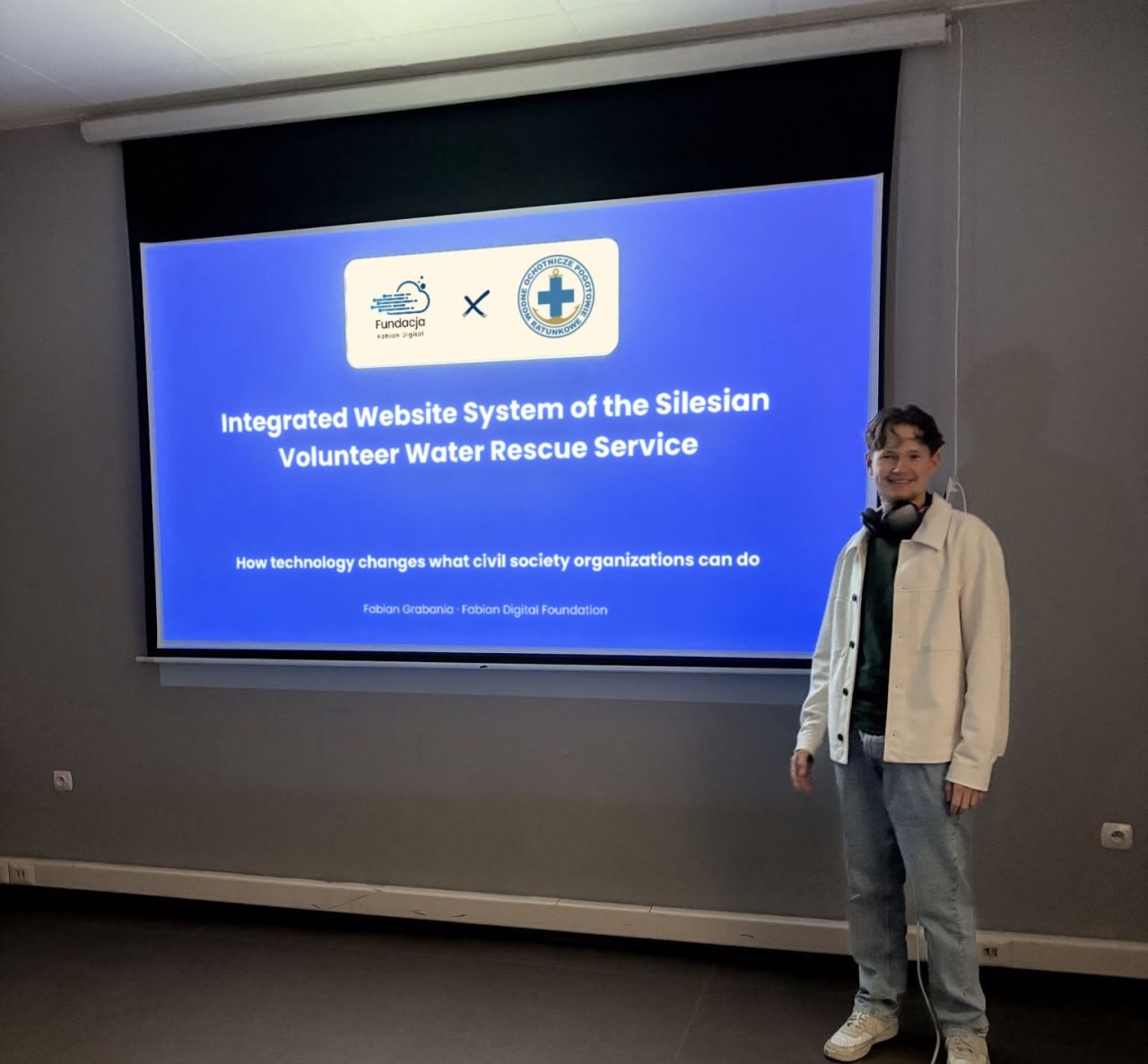
In this article, we describe how the Fabian Digital Foundation, together with Śląskie WOPR, built the Integrated Website System of Śląskie WOPR: a single, consistent network of branch websites, based on a shared template, protected at the network edge and managed from one place. It shows how technology can genuinely expand what non-profit organizations are able to do — without large budgets, but with a well-thought-out plan, good cooperation and consistent implementation.
From one website to the whole of Śląskie WOPR
It all started with a conversation with a single branch, WOPR Tychy. At first, we talked about refreshing one website. During our talks, however, it quickly became clear that the problems faced by the Tychy branch affected the other units to a similar extent. Building each new website separately would only repeat the same mistakes: separate management, separate security, separate costs and separate risks.
That is why we moved from a single website to the idea of taking care of the whole of Śląskie WOPR. The Fabian Digital Foundation and Śląskie WOPR agreed on a joint action plan and signed a cooperation agreement. The agreement defines the scope of support, the rules for working on the organization’s infrastructure and the responsibility for data, so that the cooperation has a clear framework and is lasting rather than one-off.
Śląskie WOPR — where Polish water rescue began
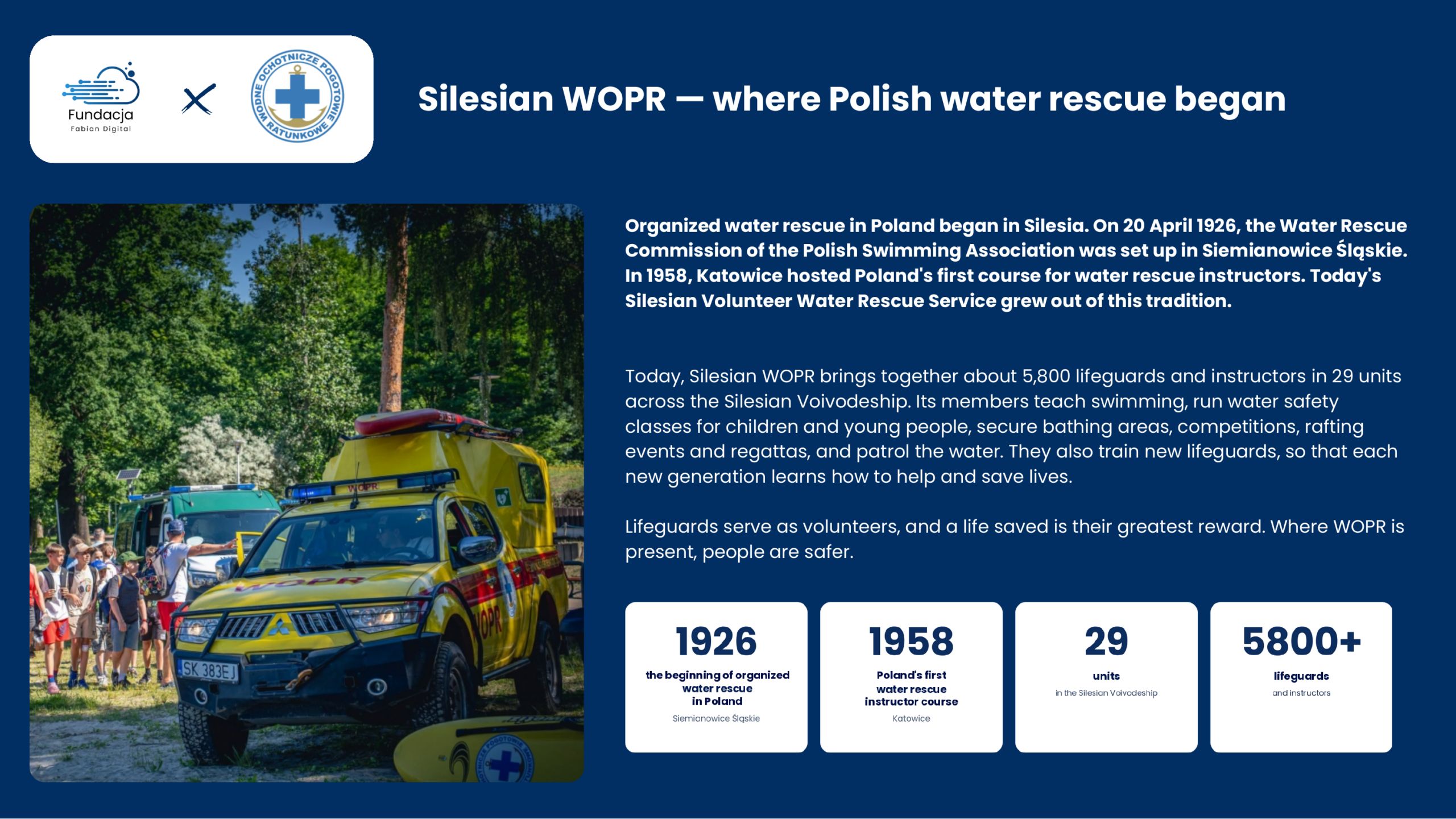
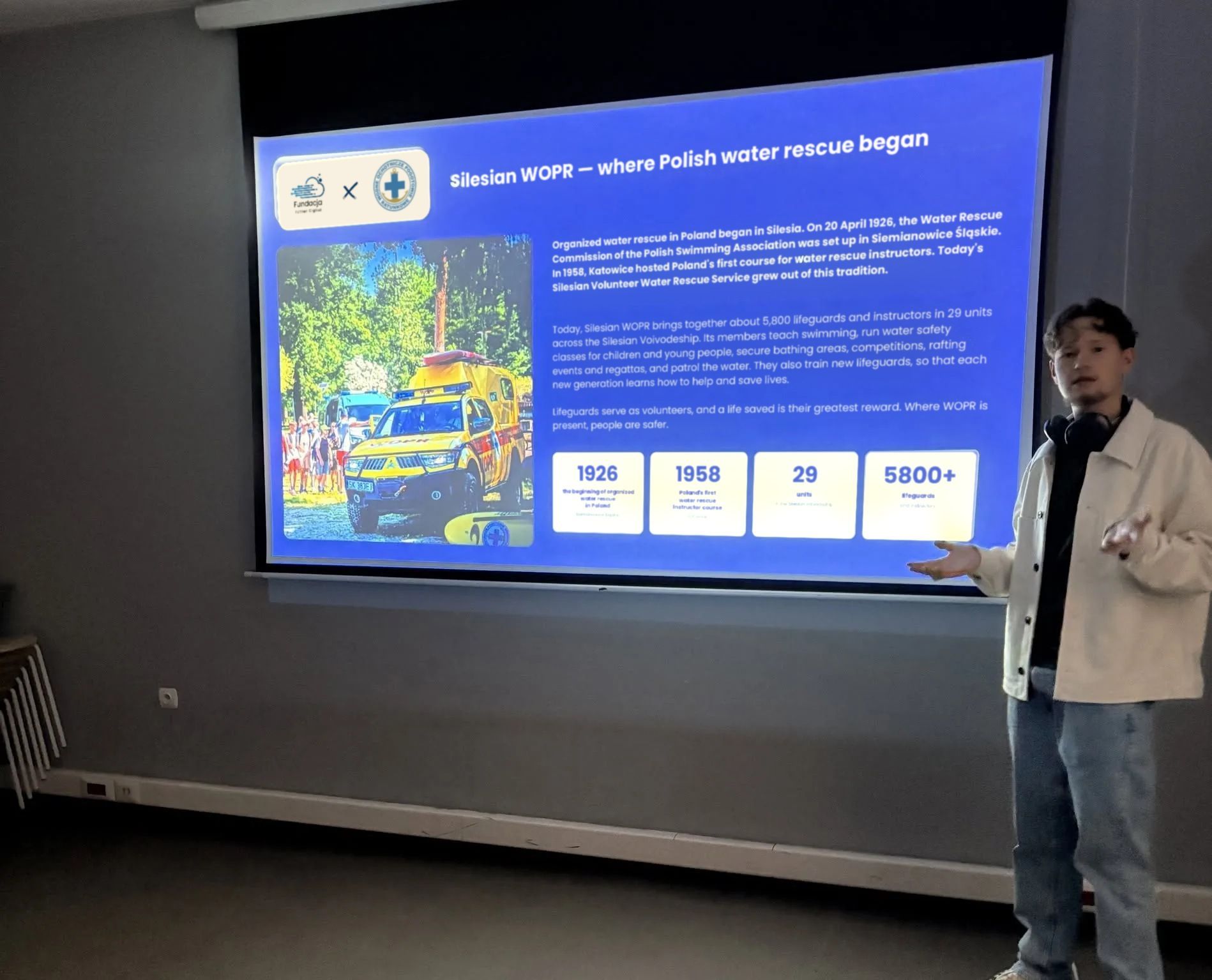
The history of organized water rescue in Poland began in Silesia. On 20 April 1926, the Water Rescue Commission of the Polish Swimming Federation was established in Siemianowice Śląskie. In 1958, the first water rescue instructor course in Poland was held in Katowice. Today’s Silesian Water Volunteer Rescue Service (Śląskie WOPR) grew out of this tradition.
Today, Śląskie WOPR brings together around 5,800 lifeguards and instructors in 29 branches across the Silesian Voivodeship. Its members teach swimming, run water safety classes for children and young people, secure swimming areas, competitions, kayaking trips and regattas, and patrol the water. They also train new water lifeguards, so that each new generation learns how to help others and save lives.
The lifeguards are volunteers, and their greatest reward is a life saved. Where there is WOPR, it is safer.
The scale of the organization is crucial to this project. 29 branches mean 29 teams, each with its own website, news, galleries and documents, and behind them many administrators and editors who publish content every day. A system built for such a structure has to be simple for every editor, consistent for visitors and very well secured at the same time.
Starting point
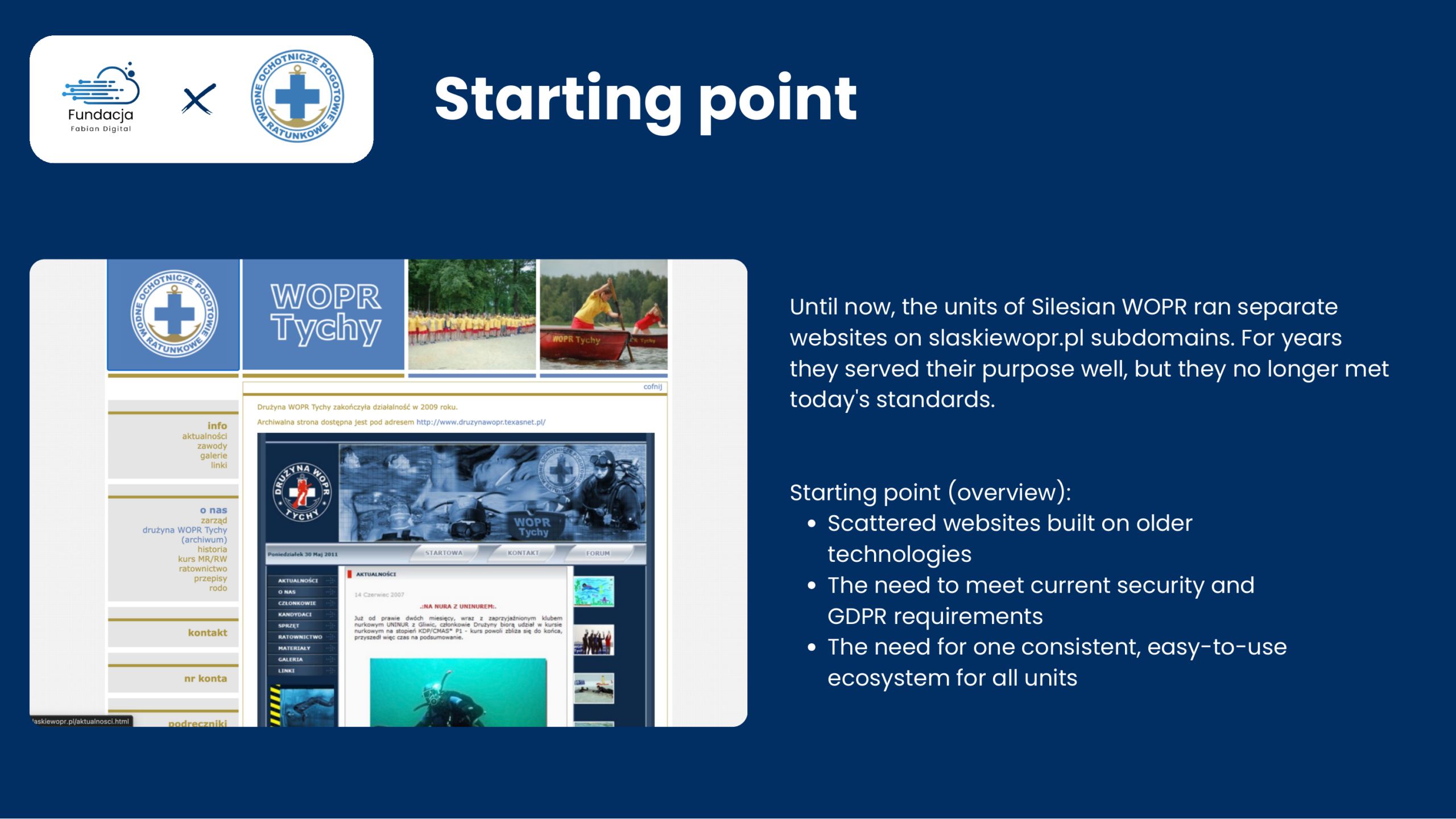
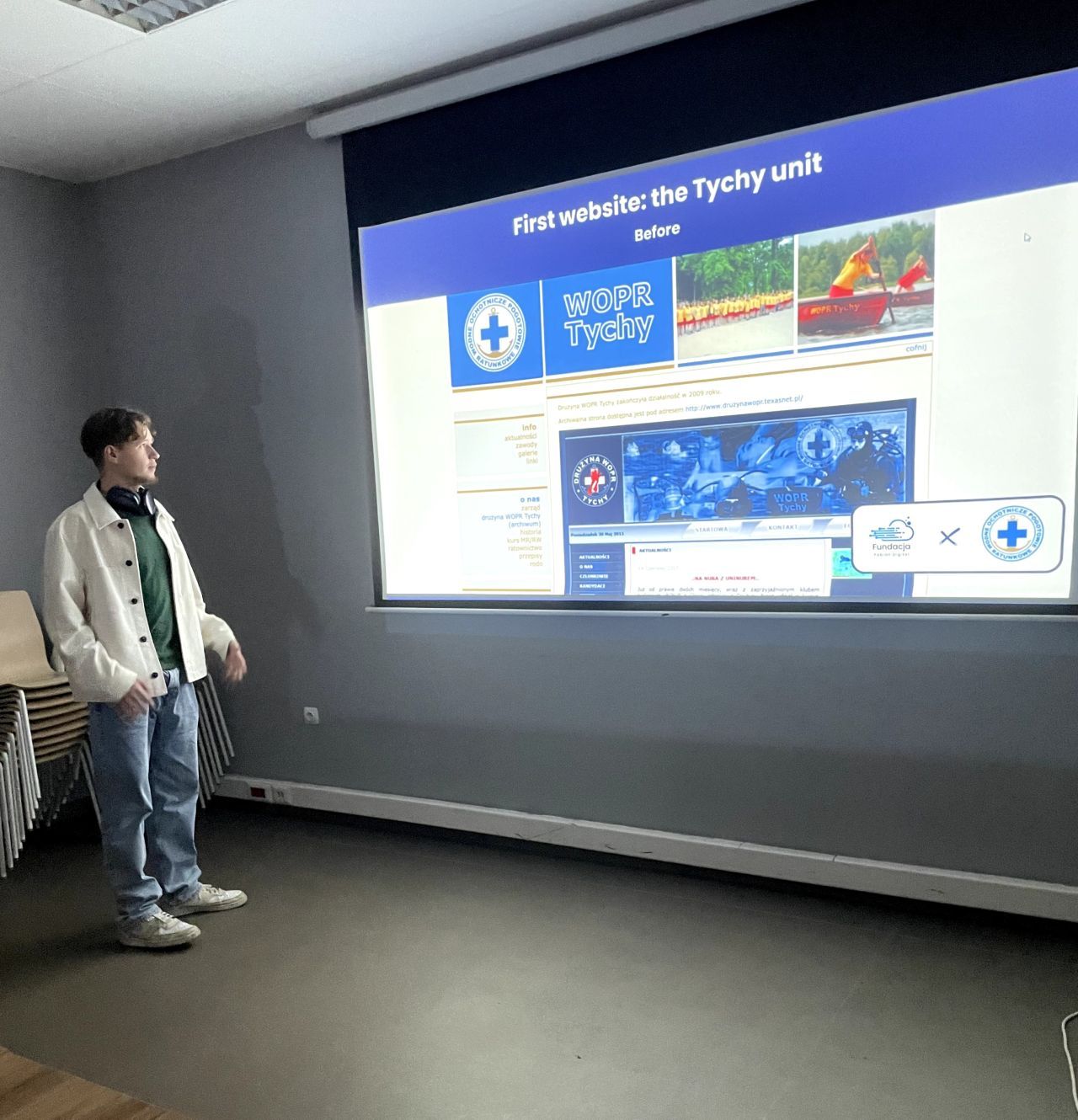
For years, the branches of Śląskie WOPR relied on individual websites hosted on subdomains of slaskiewopr.pl. These sites served their purpose well when they were created, but they no longer met today’s standards in terms of security, ease of use or room to grow.
Visitors could find information from many years ago, and some subpages still carried announcements about teams that had stopped operating long ago. The design came from a different era of the internet, and the navigation was not adapted to mobile phones, which most visitors use today.
The overall picture looked like this:
- the websites were scattered and built on older technologies, each running separately and in its own way,
- the sites had to be brought in line with current security requirements and data protection regulations (GDPR),
- there was no single, consistent and easy-to-use ecosystem covering all of the organization’s units.
This situation is not an exception but an everyday reality for many non-governmental organizations in Poland. Websites are usually created thanks to the commitment of individual volunteers, and when those people take on other duties, the sites are left without care. Over time they stop being updated, lose their security and become an easy target for bots that scan the internet for vulnerabilities.
Research and analysis
Before writing the first line of code, we carried out a thorough review. We checked all of the organization’s domains, the condition of the existing websites, how they were maintained, and how trainees, residents and the lifeguards themselves use them. This approach avoids a situation where a new website looks better but repeats the old problems underneath.
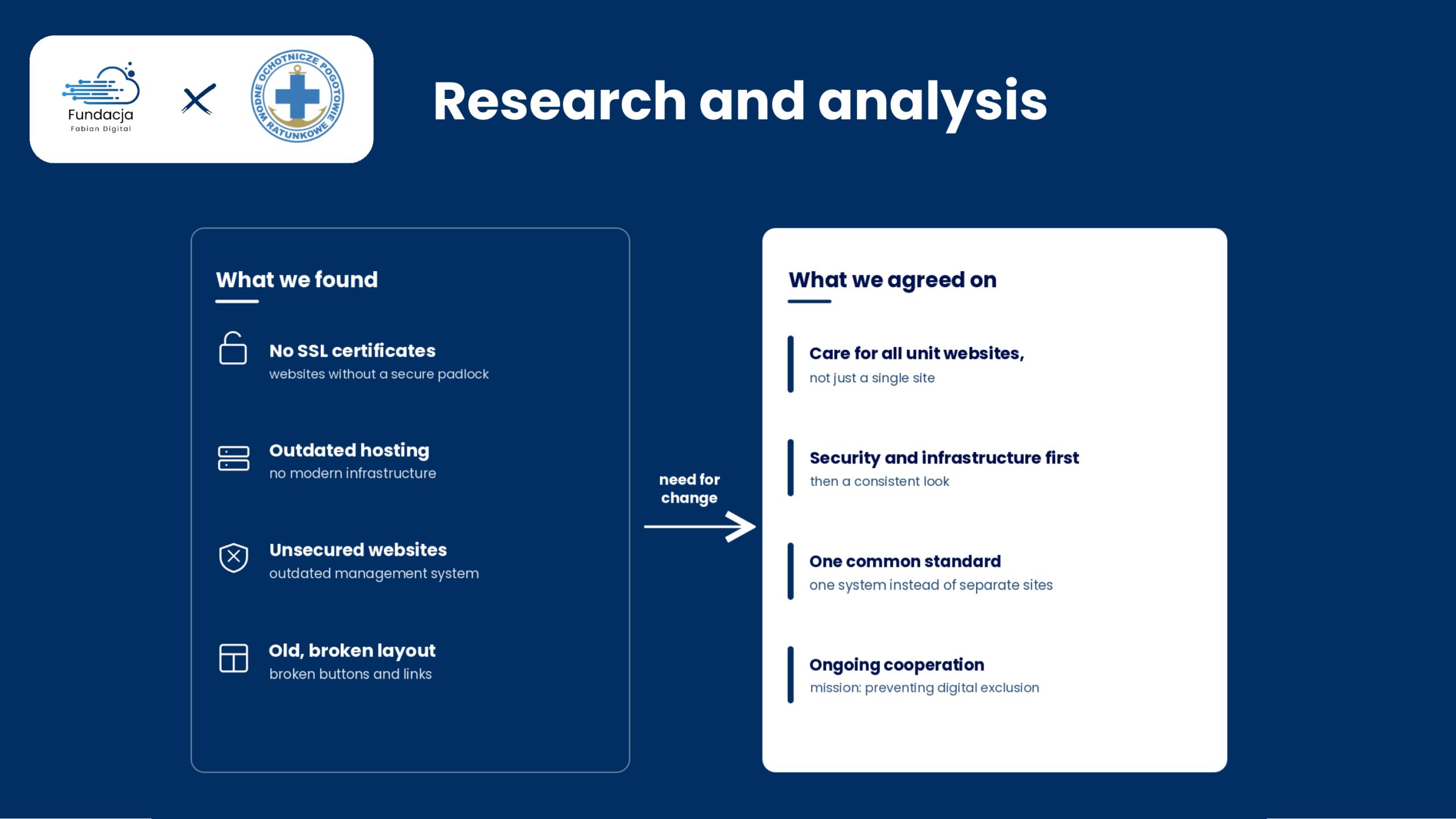
What we found
- No SSL certificates: some sites ran without the “green padlock”, and browsers warned visitors that the connection was not secure.
- Outdated hosting without a modern backend: the server environment did not allow modern tools to be installed or the sites to be managed efficiently.
- Unsecured websites built on an outdated content management system that had not received updates for years.
- An old, broken layout with non-working buttons and links, not adapted to mobile devices.
What we agreed on
- We take care of all the branch websites, not just one. Only this approach brings consistency and real security to the whole organization.
- Security and infrastructure first, design second. A beautiful website on an unsecured server is just a prettier target for attackers.
- One shared standard. Instead of a dozen separate websites, we are building a consistent system in which every branch uses the same proven solutions.
- Ongoing cooperation, not a one-off job. Our statutory goal is to counter digital exclusion, so we want the organization to be able to develop digitally in the long term.
This order (foundations first, facade second) shaped the entire course of the work that followed.
Eight domains in one place
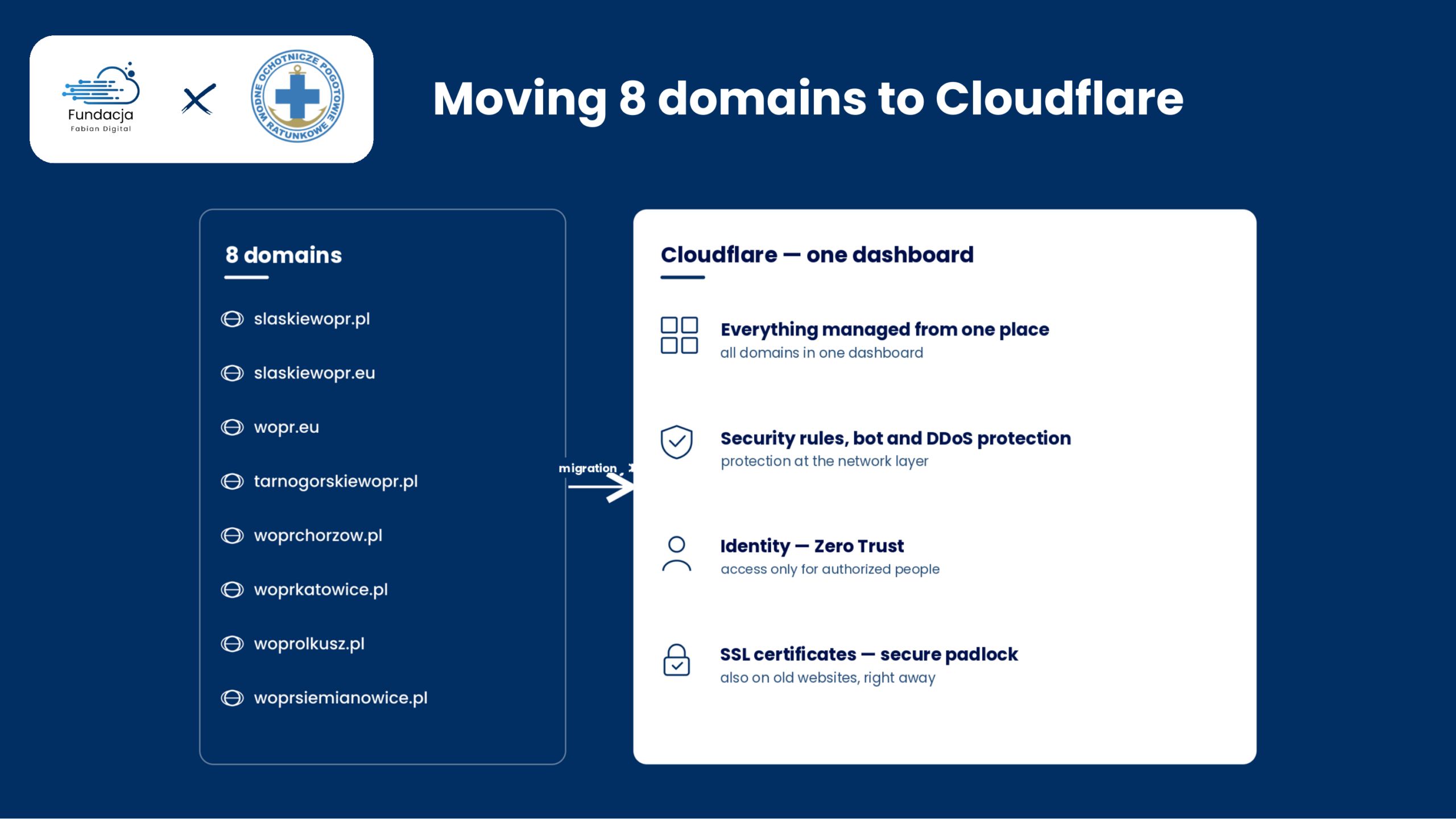
The first step was to put the domains in order. The organization used eight web addresses, registered and managed in different places:
- slaskiewopr.pl
- slaskiewopr.eu
- wopr.eu
- tarnogorskiewopr.pl
- woprchorzow.pl
- woprkatowice.pl
- woprolkusz.pl
- woprsiemianowice.pl
We moved all of them to Cloudflare, which gave the organization:
- management of all domains from a single dashboard, with no need to hunt for passwords to many different services,
- security rules and protection against bots and DDoS attacks, working at the network layer before traffic even reaches the server,
- identity control in the Zero Trust model, so that only authorized people can access internal resources,
- SSL certificates and the “green padlock” right away, even on older websites that were still waiting to be rebuilt.
This stage had an immediate effect: even before the first new website was built, all existing sites gained encrypted connections and protection against the most common attacks.
New hosting infrastructure
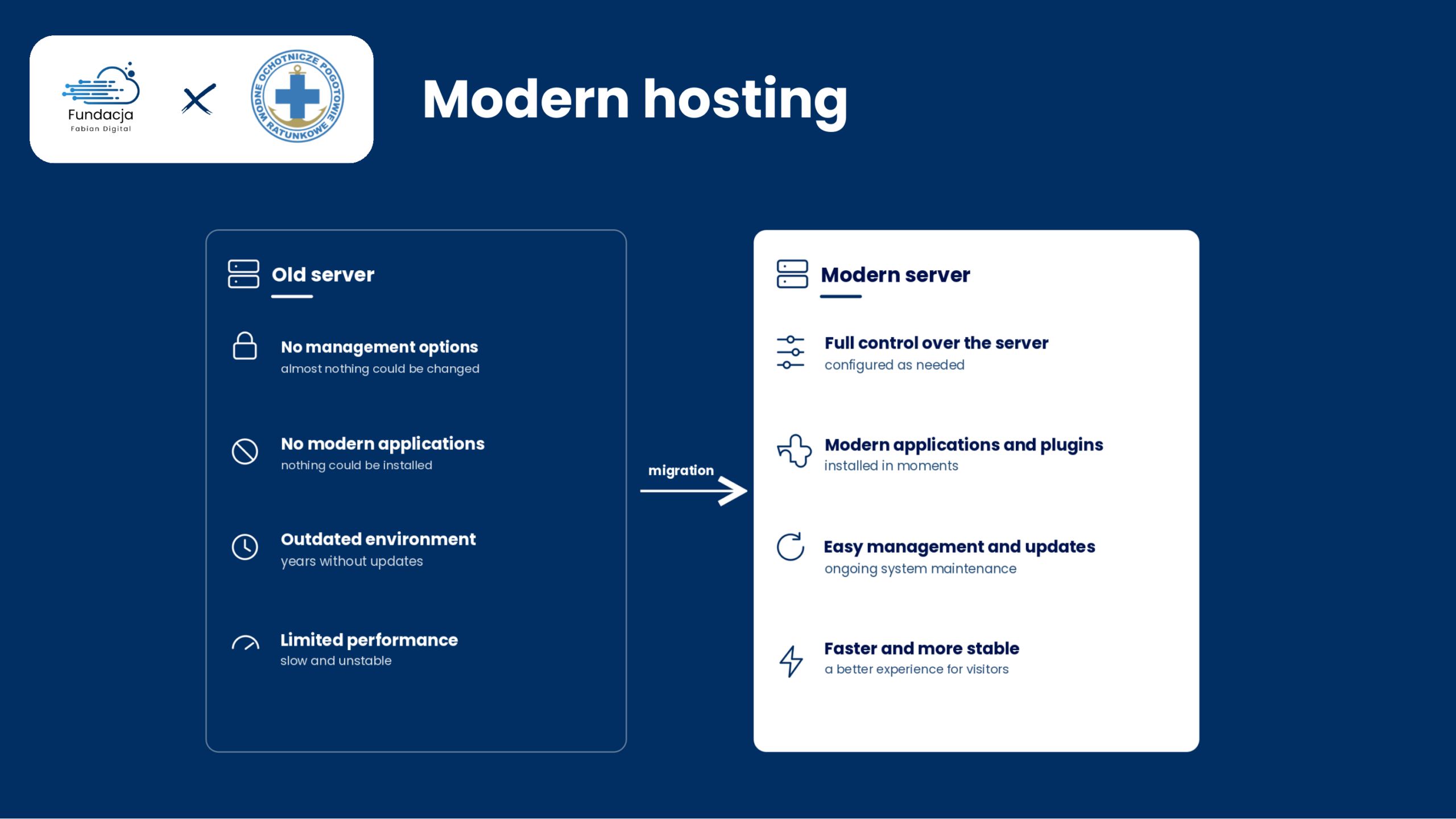
The second foundation was moving the websites to a modern hosting environment. The previous server allowed almost nothing to be changed: modern applications could not be installed on it, the software had not been updated for years, and the websites were slow and unstable.
After the migration, the organization uses an environment that:
- can be configured to suit the needs of the branches,
- allows modern applications and plugins to be installed in moments,
- is easy to manage and regularly updated as part of ongoing maintenance,
- runs faster and more reliably, which visitors notice from the very first click.
The new infrastructure became the base for all the other parts of the system.
The first website: the Tychy Regional Branch
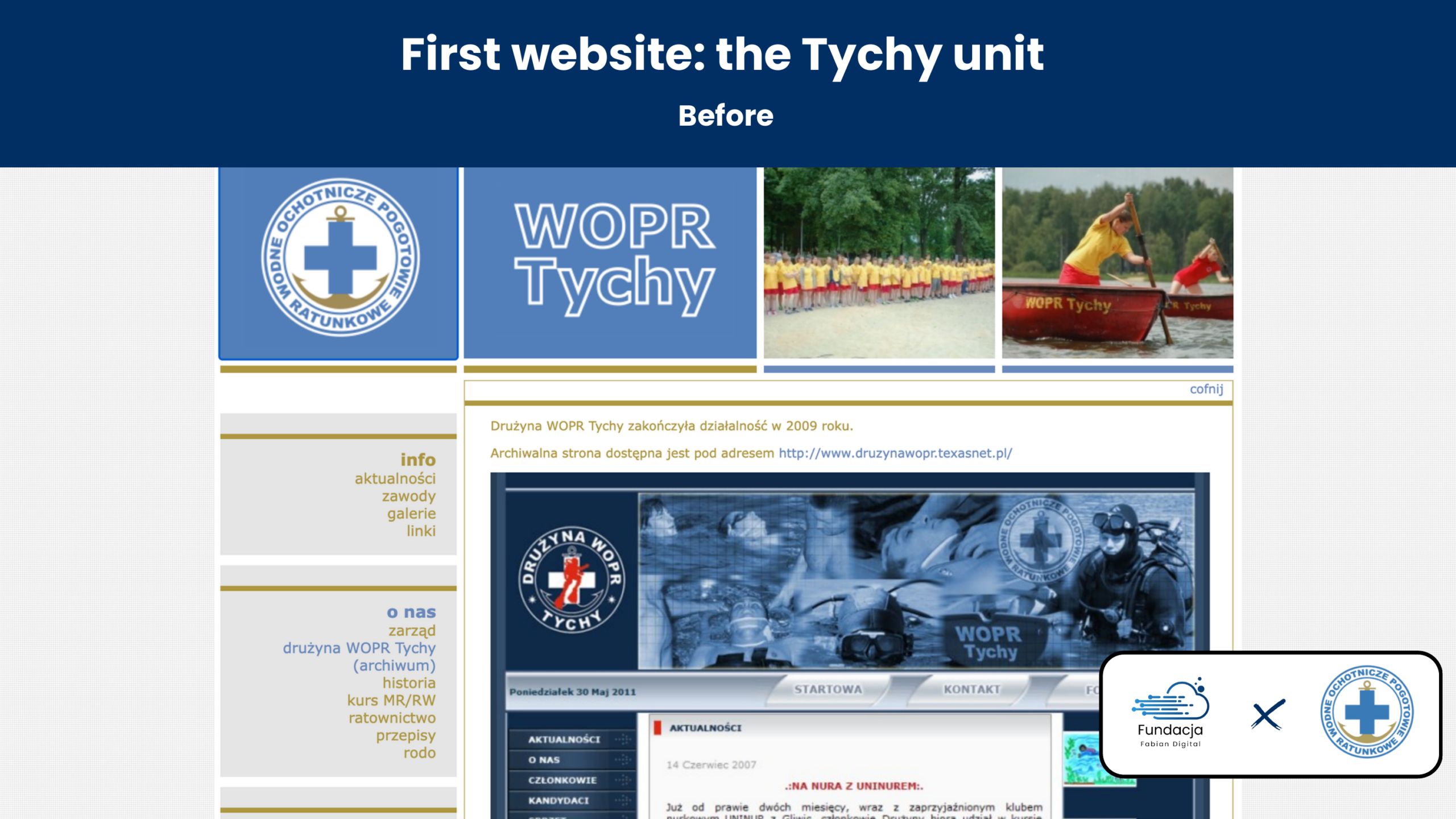
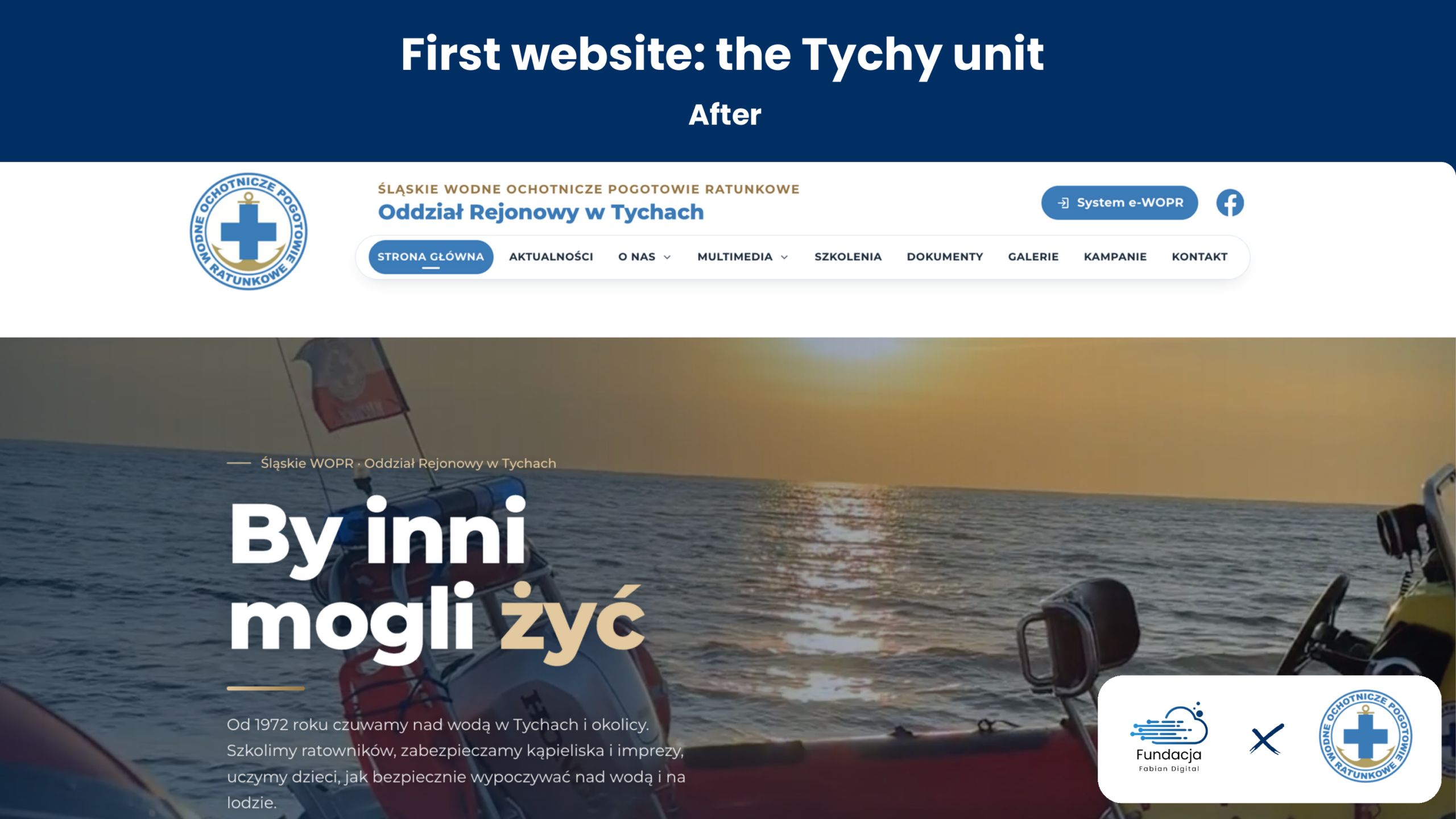
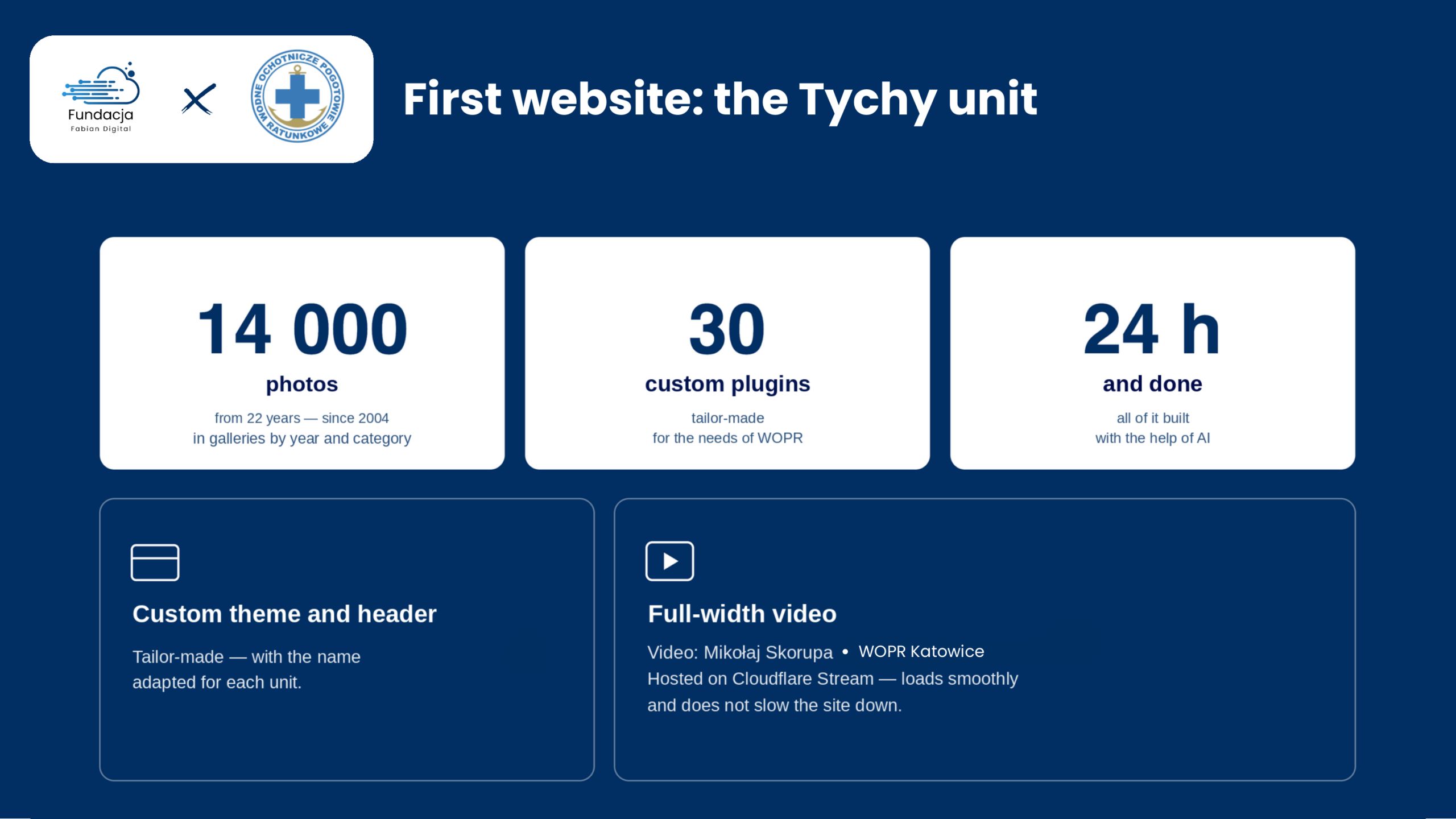
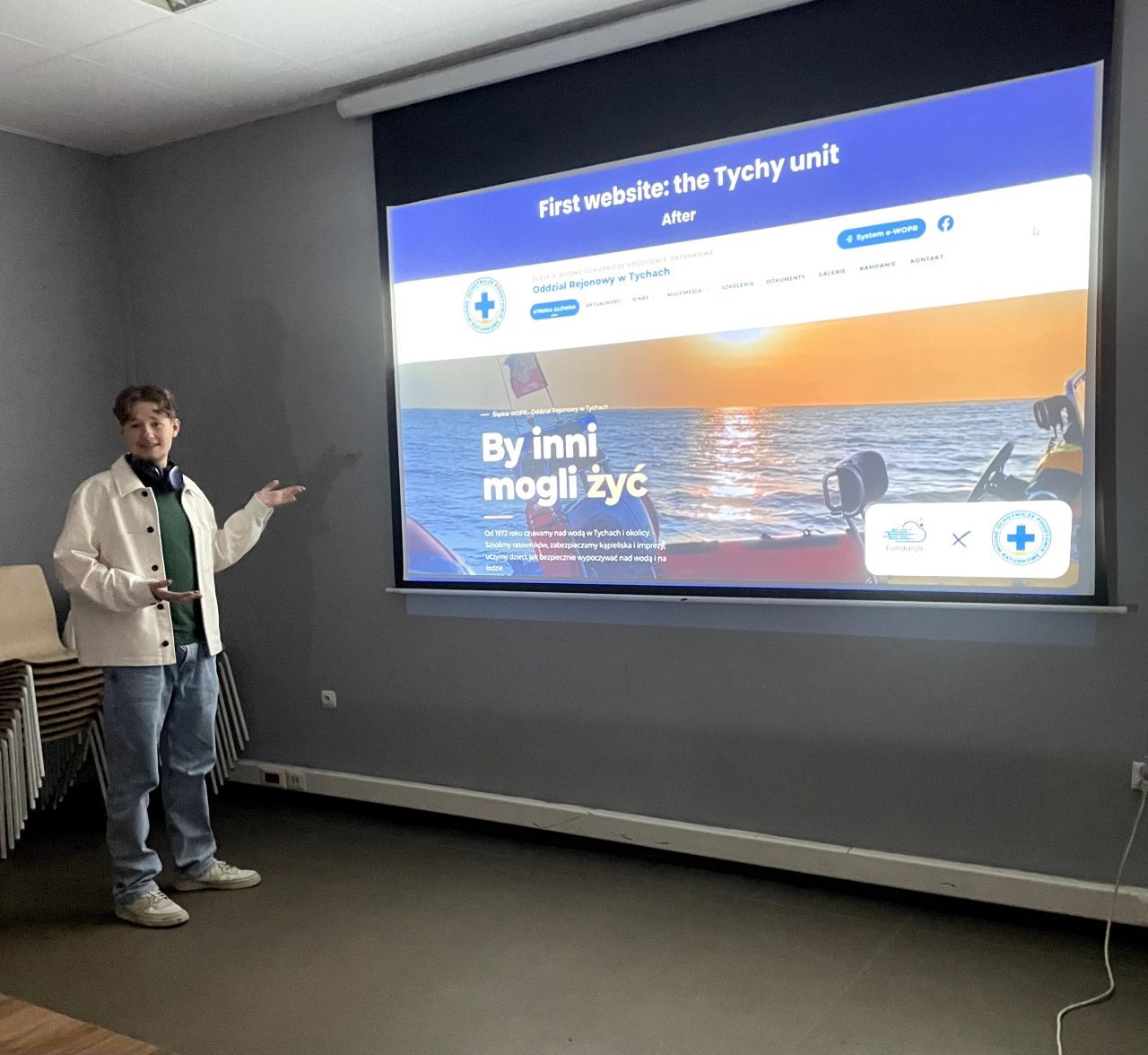
Once the foundations were ready, we began building the first new website, for the Tychy branch, where the whole cooperation started. The old site greeted visitors with information about a team that had stopped operating in 2009 and with news from more than a decade earlier. The new website opens with a full-width video and the motto that has guided lifeguards for generations: “So that others may live” („By inni mogli żyć”).
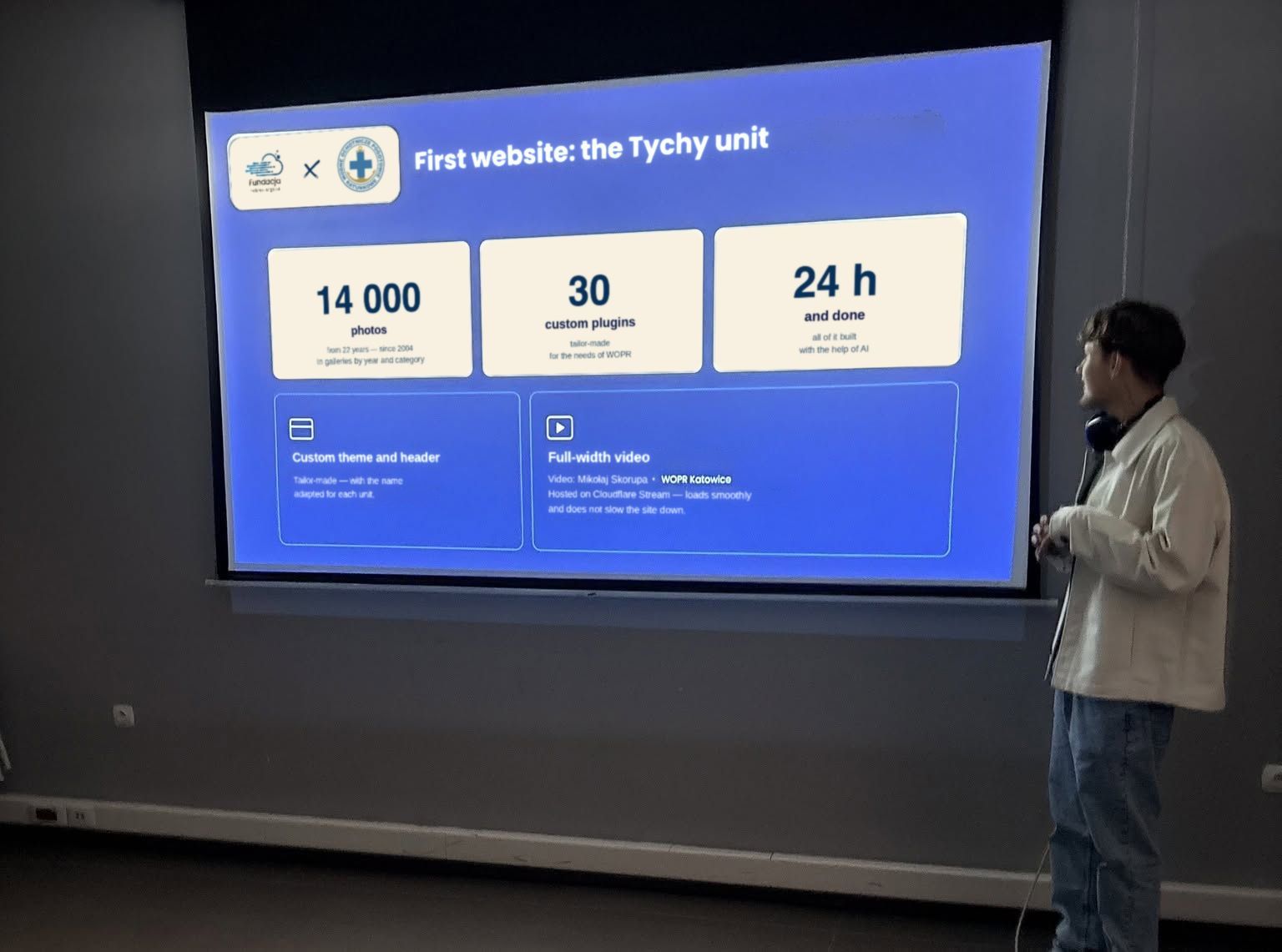
A few numbers show the scale of this work:
- 14,000 photos from 22 years of activity, since 2004, organized into galleries by year and category. This is a large part of the branch’s history that was previously scattered and practically inaccessible.
- 30 custom plugins, tailored to the needs of WOPR: from the header, news and galleries, through contact cards, training enrollment and textbooks, to a donation module and a list of grants from public funds.
- About one day of work on the first version of the website, thanks to a well-planned process and work with artificial intelligence tools.
The website has a custom theme and a header with a name adapted to each branch. The welcome video was edited by Mikołaj Skorupa from WOPR Katowice and is hosted on Cloudflare Stream, so it loads smoothly and puts no load on the website or the server.
Content migration was also an important part of the project. We moved posts and news from the old websites to the new system so that the branch’s history would not be lost when the old site was switched off.
E-textbooks for trainees
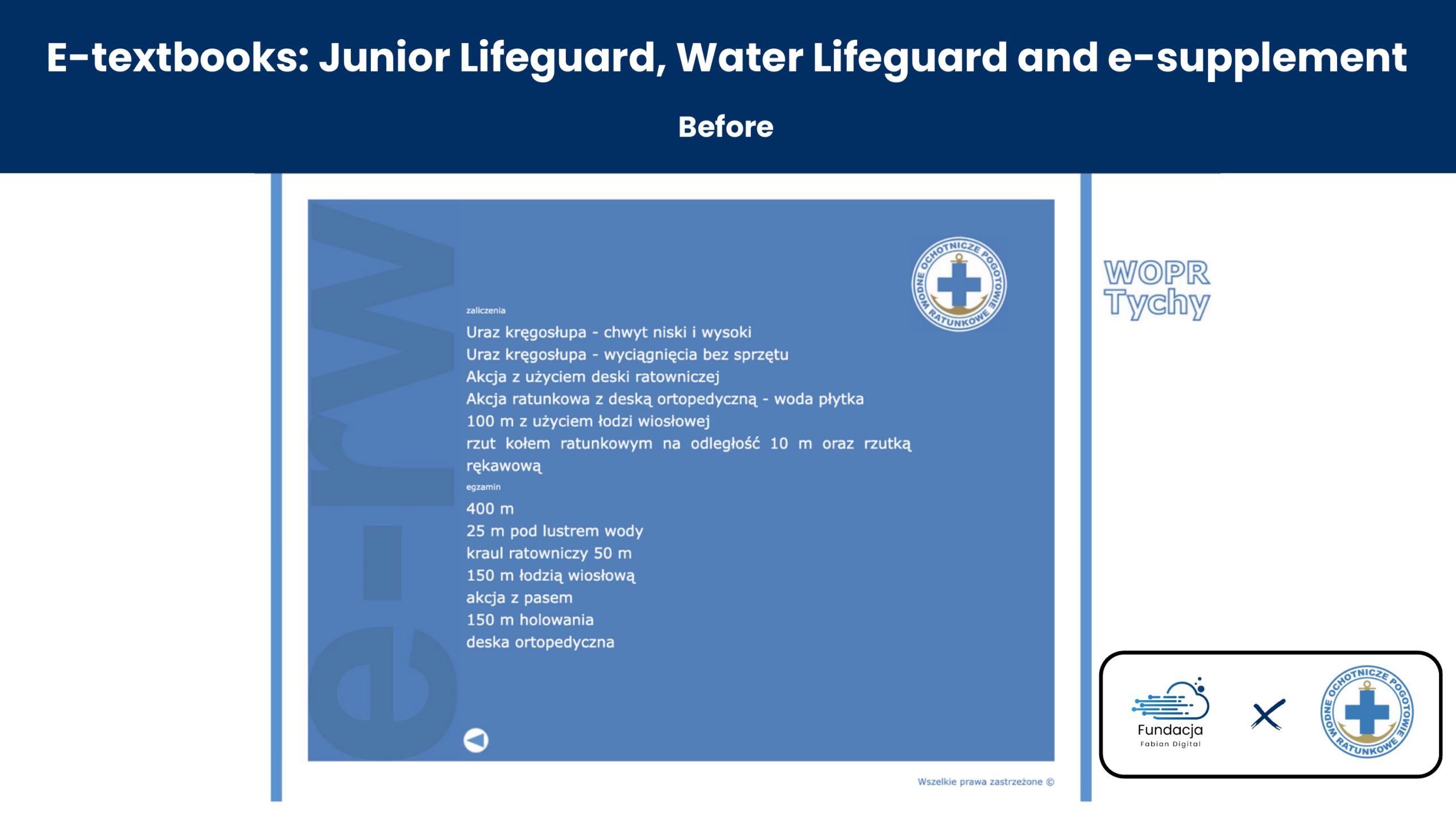
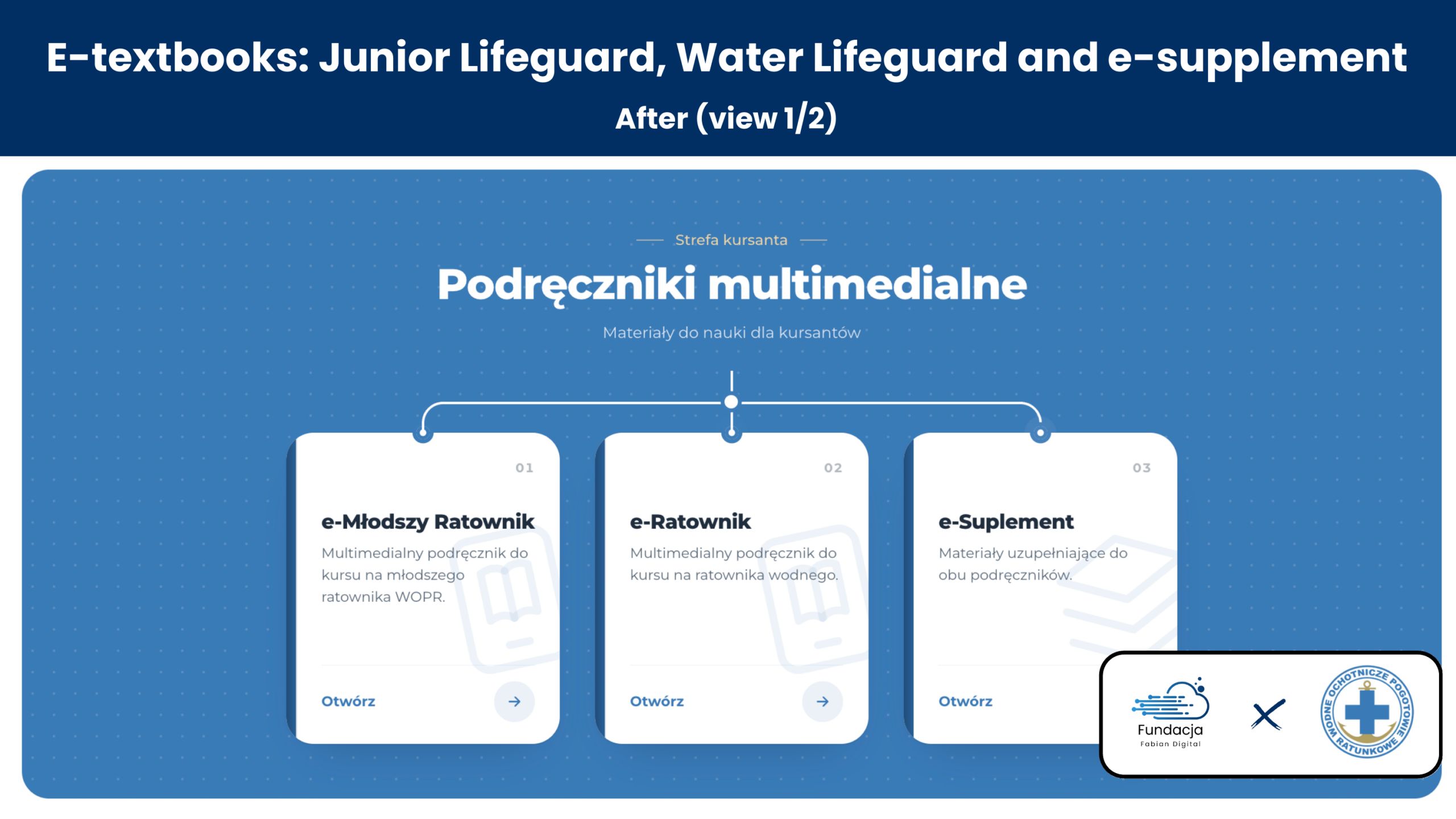
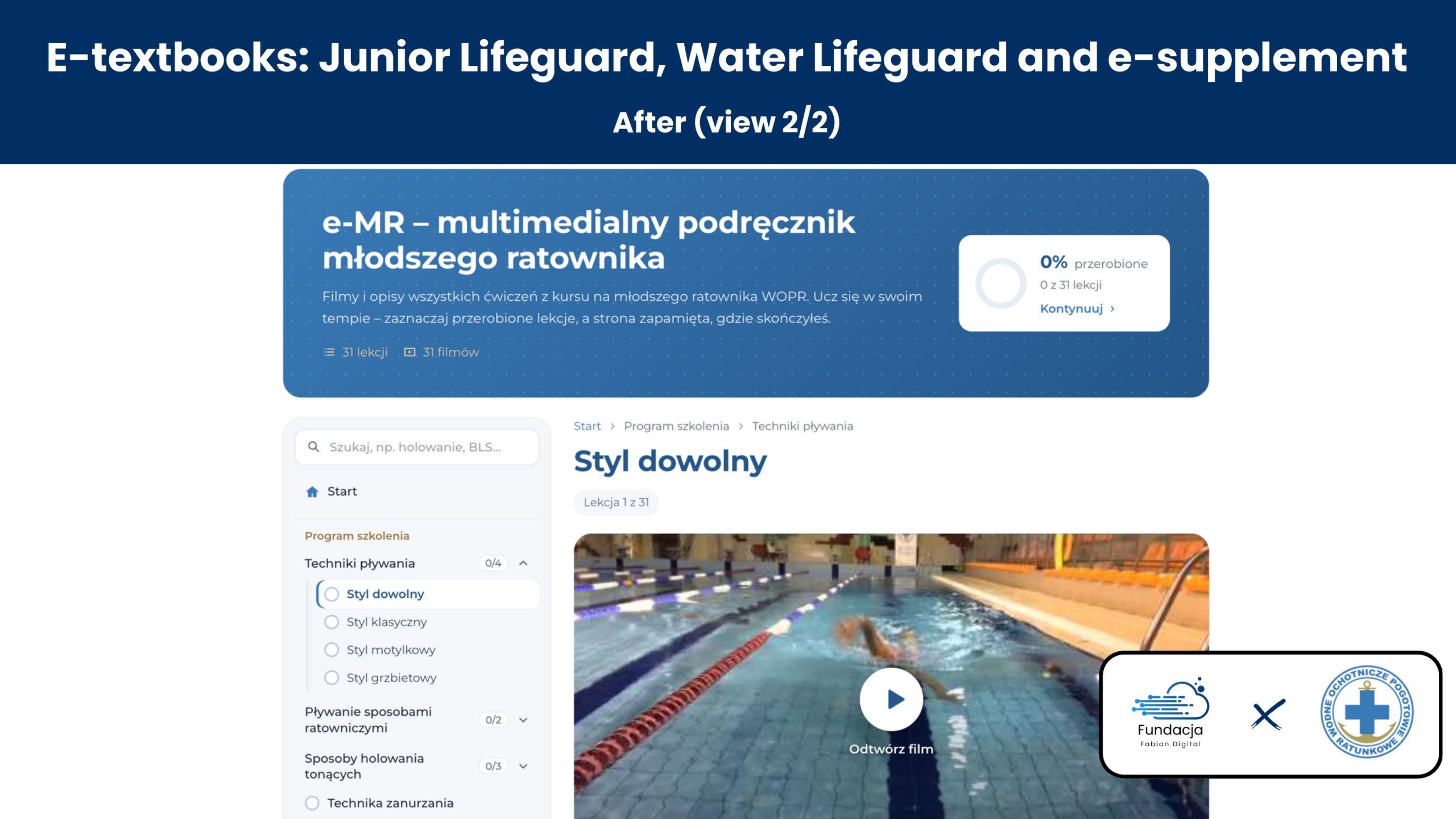
A particularly important part of the system is the set of multimedia textbooks for people preparing for lifeguard courses. Previously, the materials were a simple list of exercises on a plain background, with no videos, no search and no way to track progress.
Three textbooks are available in the new Trainee Zone:
- e-Junior Lifeguard (e-Młodszy Ratownik): a multimedia textbook for the WOPR junior lifeguard course,
- e-Lifeguard (e-Ratownik): a multimedia textbook for the water lifeguard course,
- e-Supplement (e-Suplement): supplementary materials for both textbooks.
The junior lifeguard textbook includes 31 lessons and 31 videos showing every exercise from the course: from swimming techniques, through lifesaving swimming styles and towing drowning persons, to diving technique. Trainees can learn at their own pace, mark completed lessons and use the search, and the website remembers where they left off. This is real support for young people preparing for the responsible role of a lifeguard.
Shared visual identity
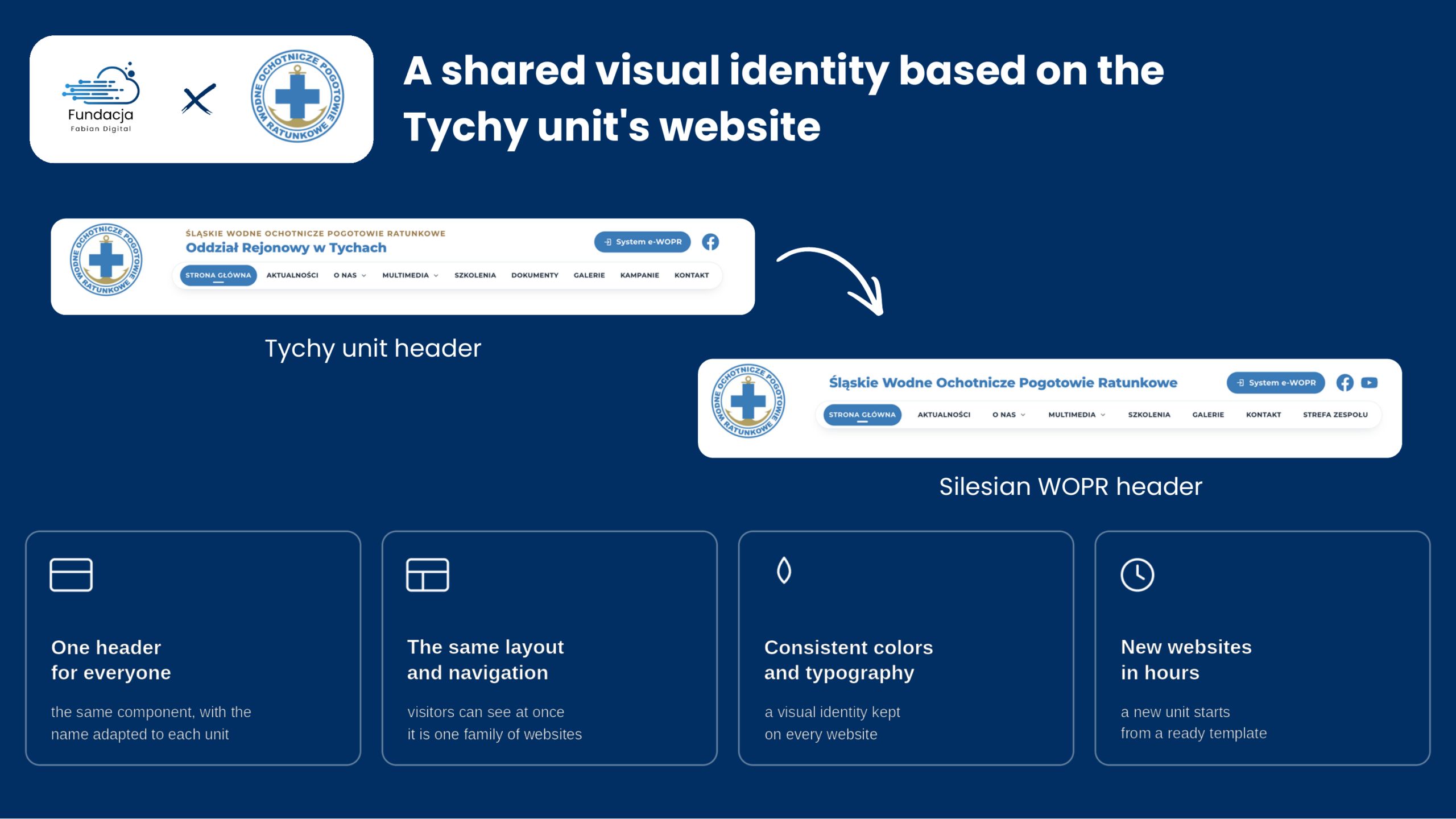
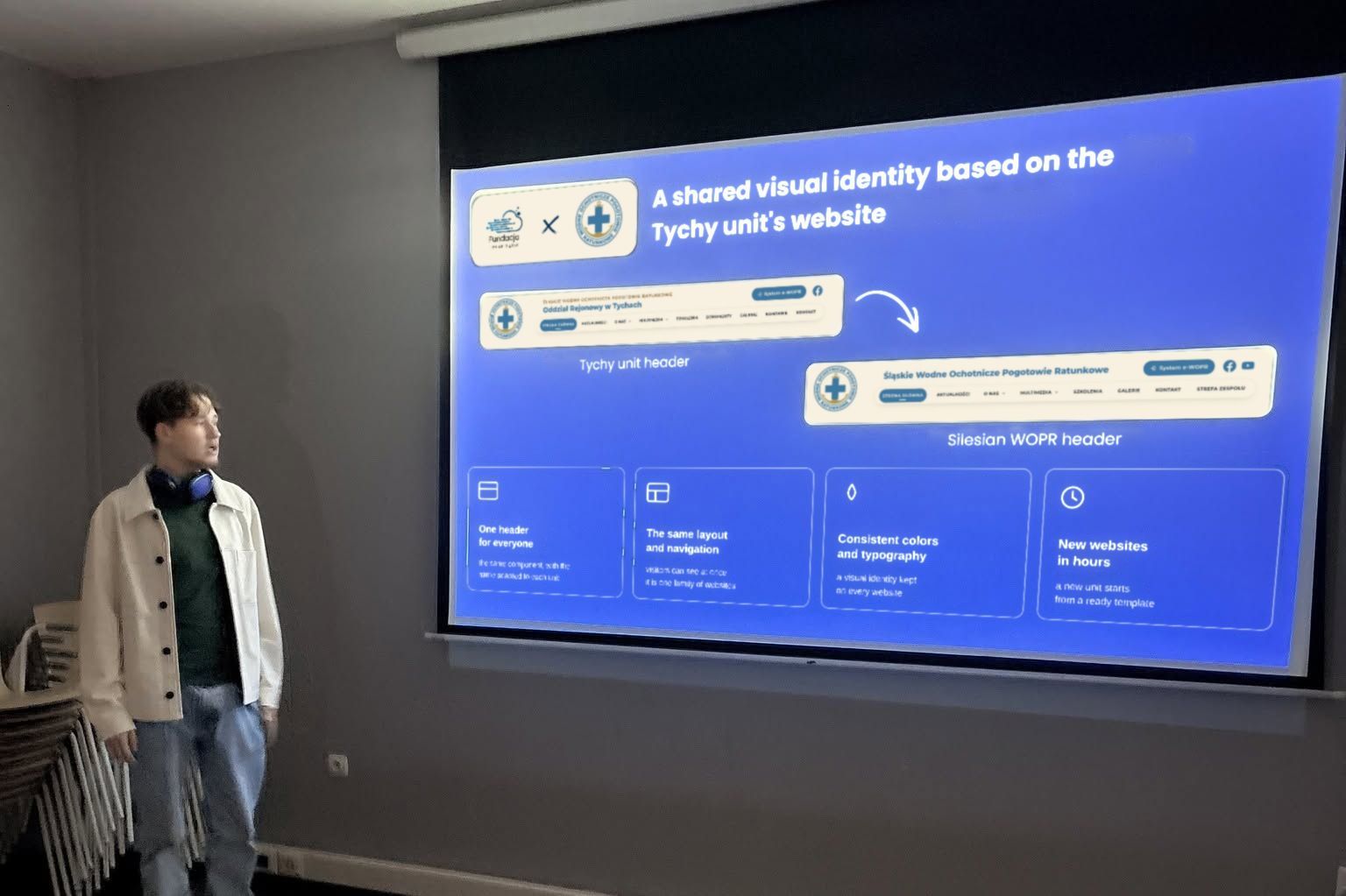
The Tychy branch website became the model for the entire system. Based on it, we created a shared visual identity for all Śląskie WOPR websites:
- one header for all: the same component, with the name adapted to each branch,
- the same layout and navigation, so visitors immediately know they are in one family of websites,
- consistent colors and typography, maintained on every site,
- new websites in hours instead of weeks, because a new branch starts from a ready-made template.
We built the main Śląskie WOPR website at slaskiewopr.pl on the same template. The previous version, with a side menu, a search box and a layout from years ago, was replaced by a modern website with clear navigation, a news section, galleries, training information and an entrance to the Team Zone. The homepage also recalls the organization’s history: Silesia was one of the cradles of Polish water rescue, and as early as 1926 the Polish Swimming Federation established its Water Rescue Commission, based in Siemianowice.
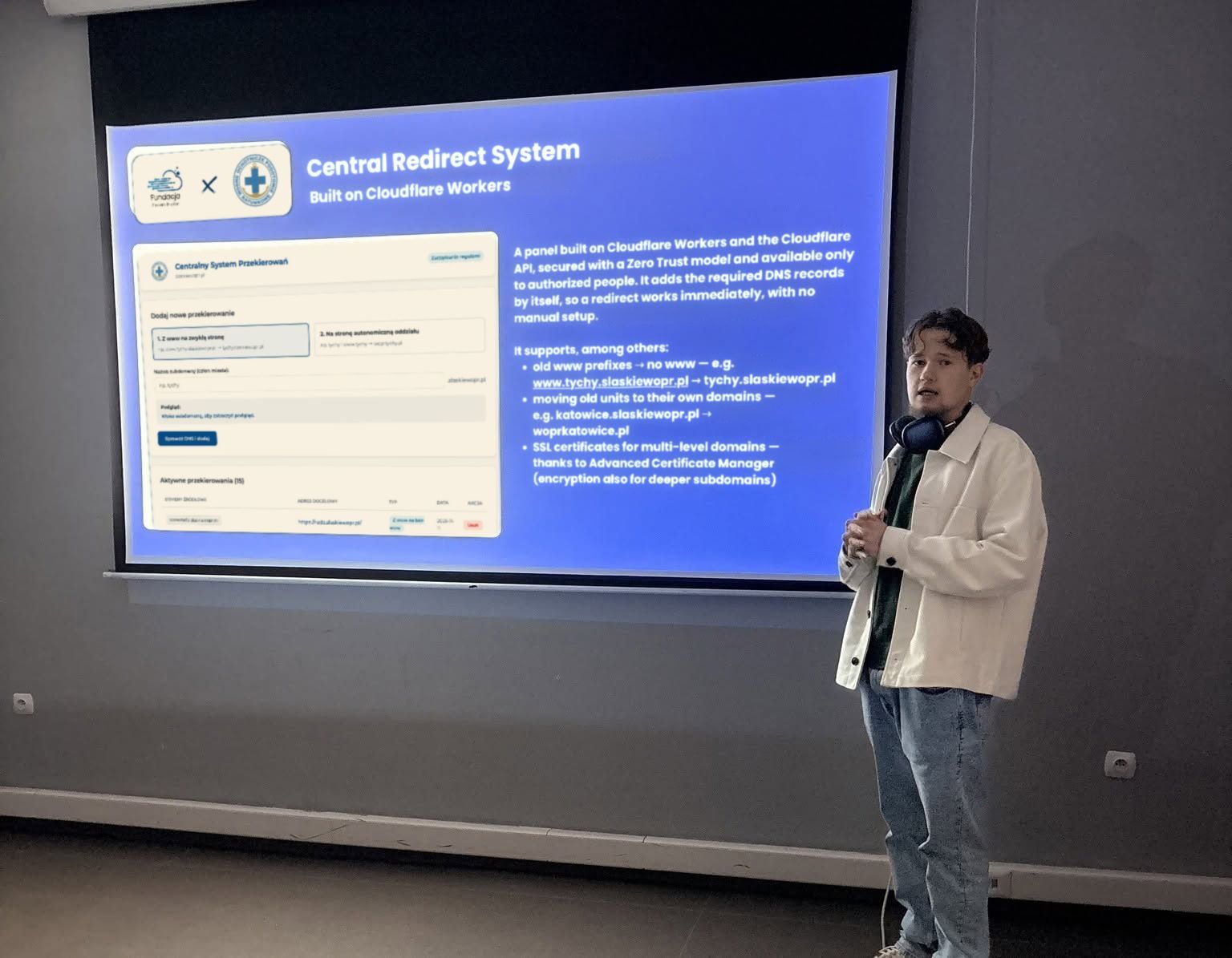
Central Redirect System
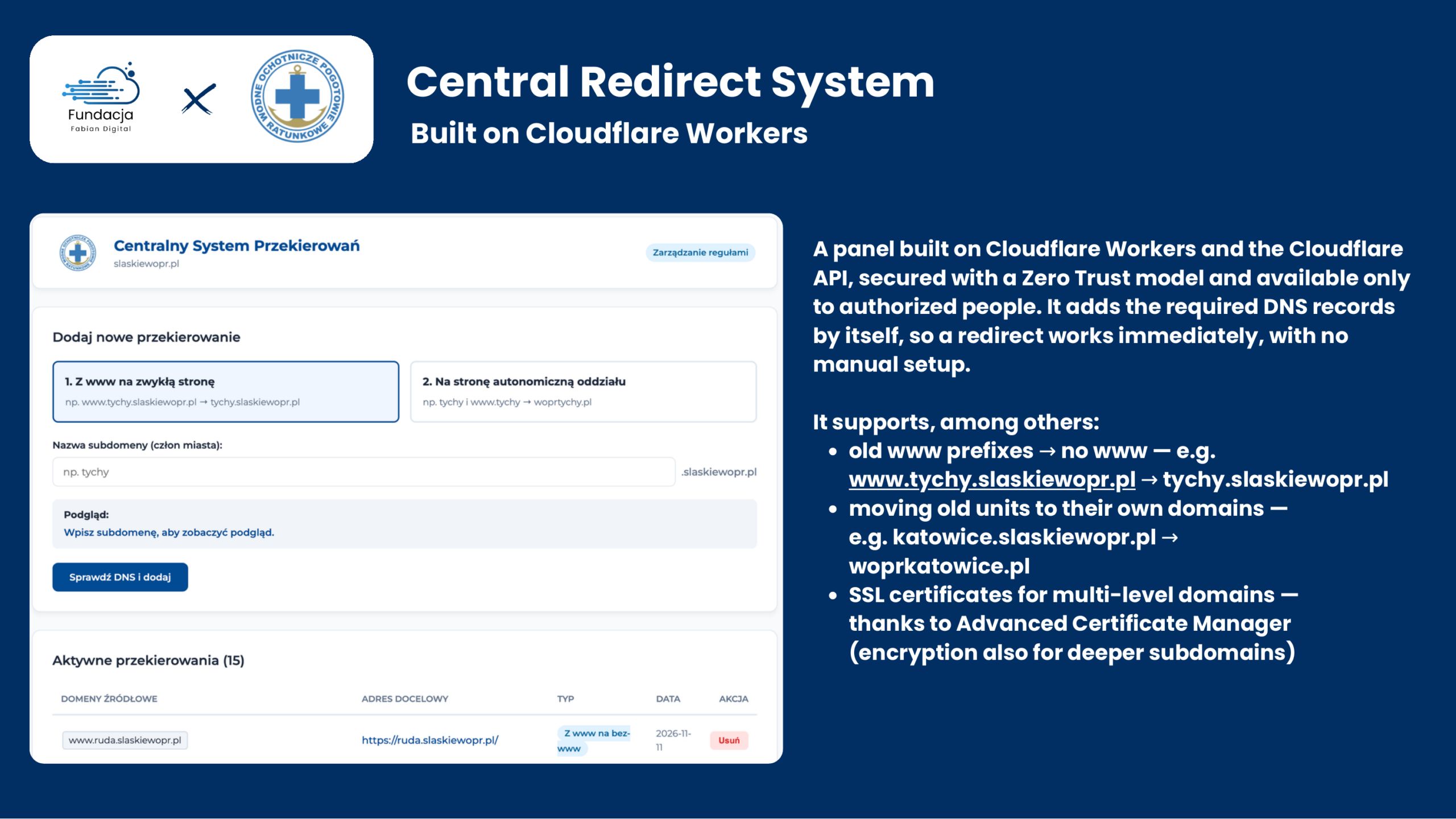
Rebuilding more than a dozen websites means changing many addresses. Old links circulate in documents, on posters, in browser bookmarks and in search results. If they stopped working after the changes, visitors would end up on error pages.
That is why we built the Central Redirect System: a dashboard based on Cloudflare Workers and the Cloudflare API, secured with the Zero Trust model and available only to authorized people. The dashboard adds the required DNS records automatically, so a redirect starts working immediately, without any manual configuration.
Among other things, the system handles:
- old www prefixes, for example redirecting www.tychy.slaskiewopr.pl to tychy.slaskiewopr.pl,
- moving branches to their own domains, for example redirecting katowice.slaskiewopr.pl to woprkatowice.pl,
- SSL certificates for multi-level addresses thanks to Advanced Certificate Manager, so that encryption also works on deeper subdomains.
As a result, changing an address no longer requires technical knowledge or help from an IT specialist: you simply choose the redirect type and enter the branch name.
Team Zone
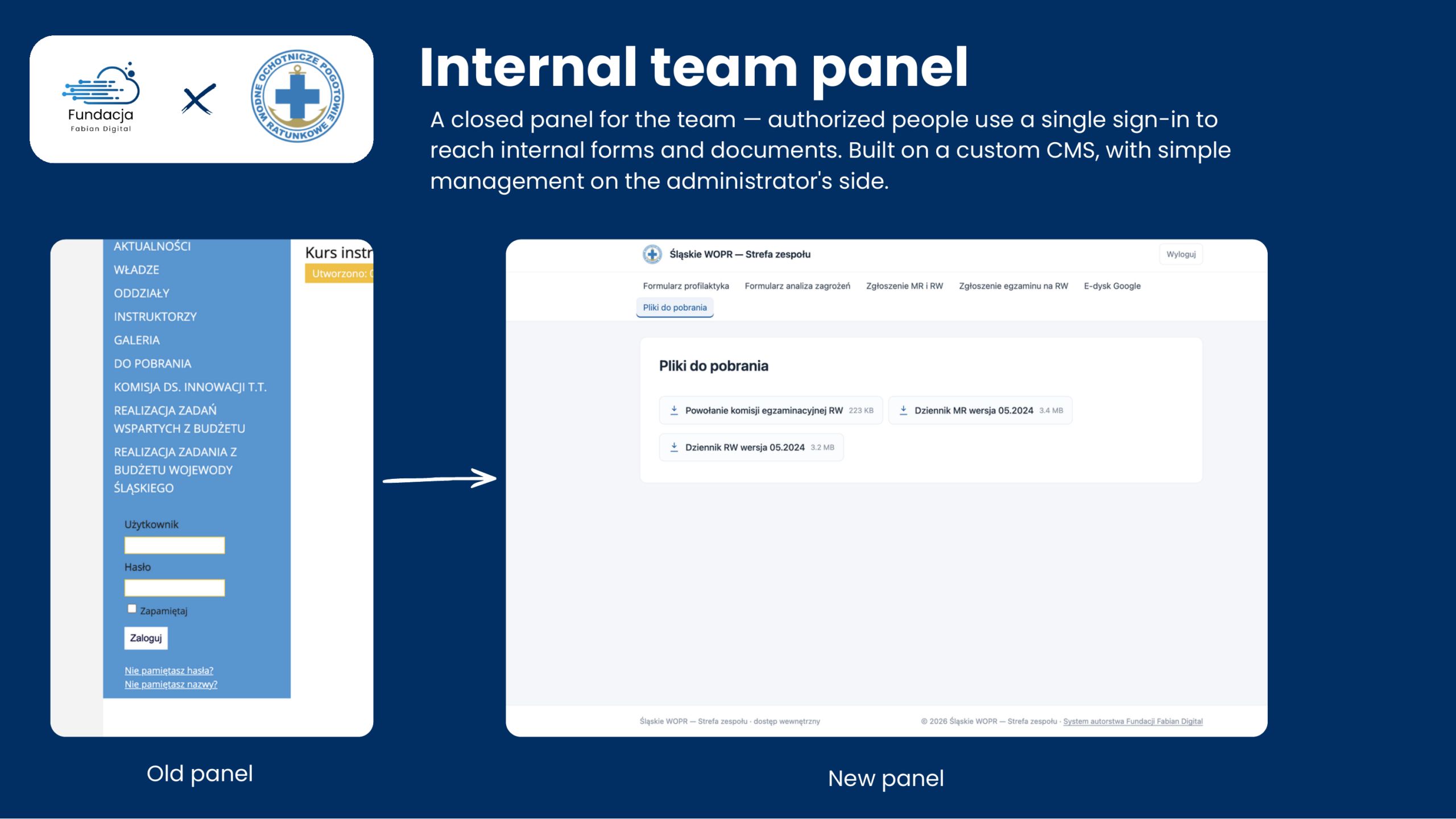
Besides the public websites, lifeguards need a place for internal documents and forms. Previously, this was handled by a simple login form built into the side menu of the old website.
The new Team Zone is a closed portal where authorized people use a single login to access internal forms and documents: prevention and risk assessment forms, applications for junior lifeguard and water lifeguard courses, exam applications, a shared drive and downloadable files such as course logs and examination board documents. We built the portal on a custom content management system, with simple management for administrators.
Central Authorization System
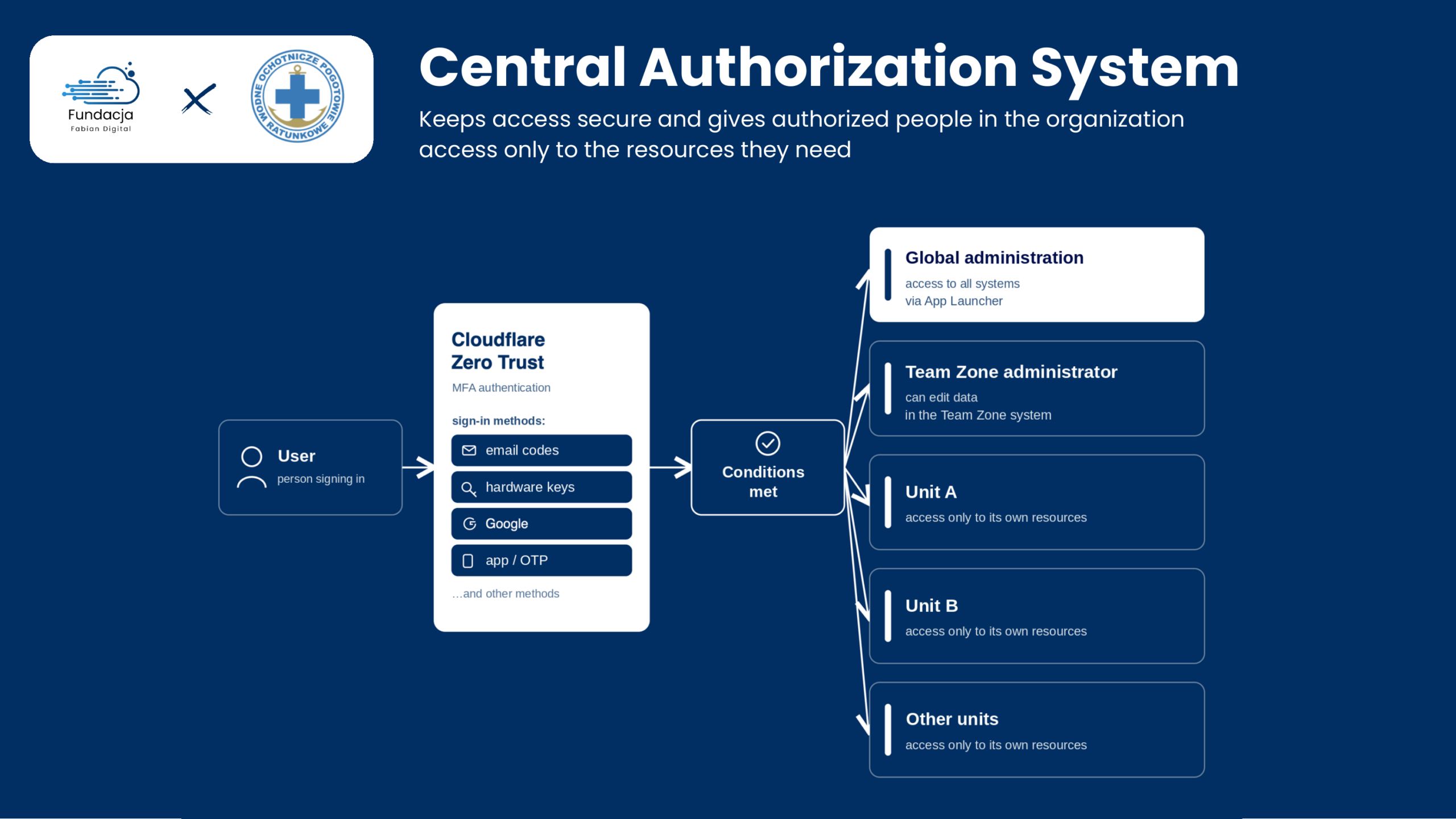
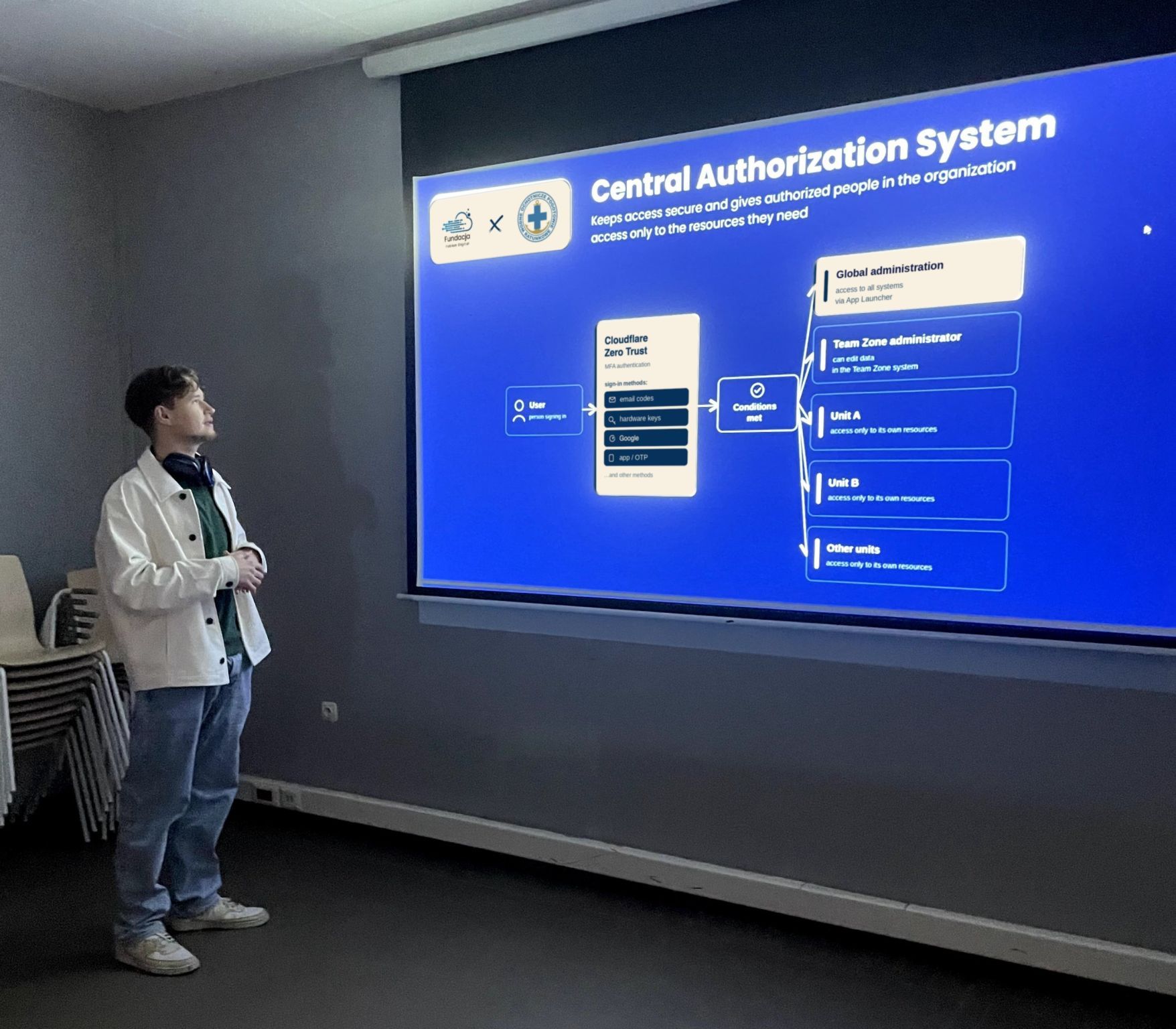
Access to internal resources is protected by the Central Authorization System, based on Cloudflare Zero Trust. It ensures secure and accountable separation of access: each person sees only the resources they are authorized to use.
Logging in requires multi-factor authentication (MFA). Options include one-time codes sent by email, physical security keys, signing in with a Google account and authenticator apps. Once the conditions are met, the system directs the user to the resources that match their role:
- global administrators have access to all systems through the App Launcher,
- the Team Zone administrator can edit data in the Team Zone system,
- individual branches have access only to their own resources.
This is the model used by large companies and institutions: no one is trusted by default, and every access attempt is verified. A person without authorization is stopped at the network edge before their request even reaches the server.
At the scale of Śląskie WOPR, access control is one of the most important parts of the whole project. We are rolling out the system gradually to more of the 29 branches, and each of them has its own administrators and editors. That means dozens of accounts with different permissions. Without central identity management, it is easy to end up with passwords being passed around, no one knowing who has access to what, and people who have left still being able to log in. The Central Authorization System solves this problem: access is granted and revoked in one place, everyone logs in with their own identity, and permissions are assigned by role and branch.
Edge protection with Project Galileo
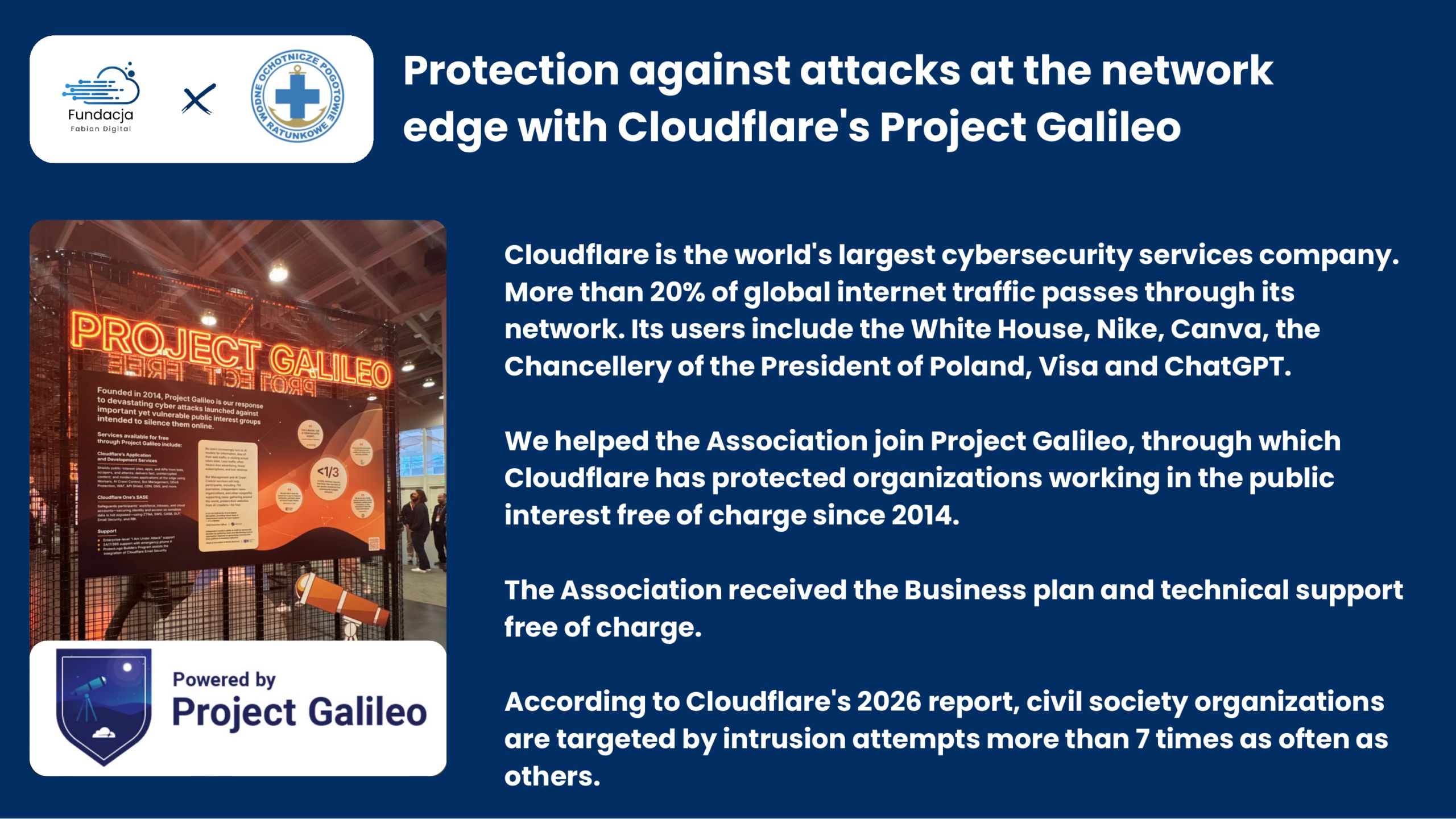
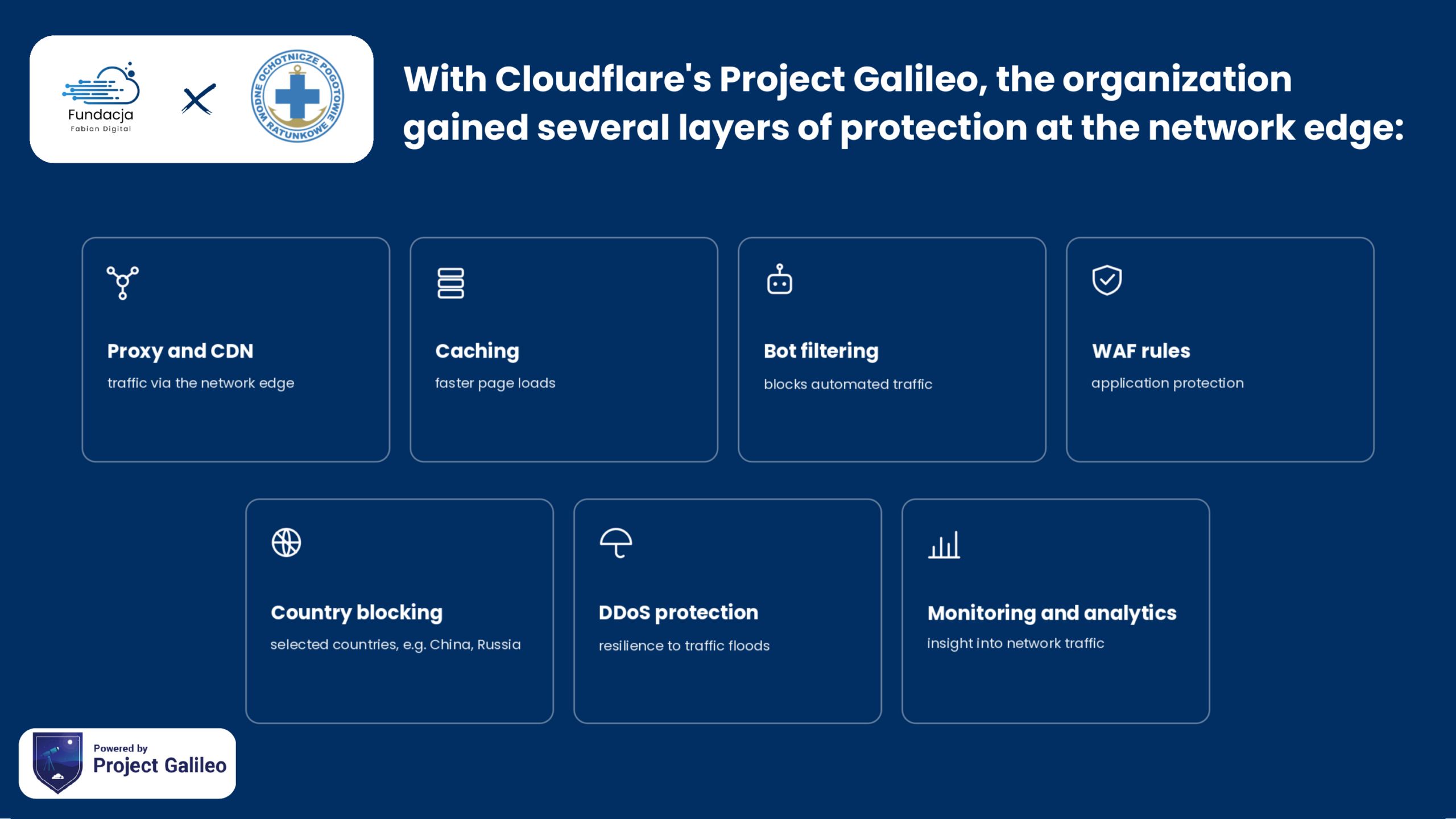
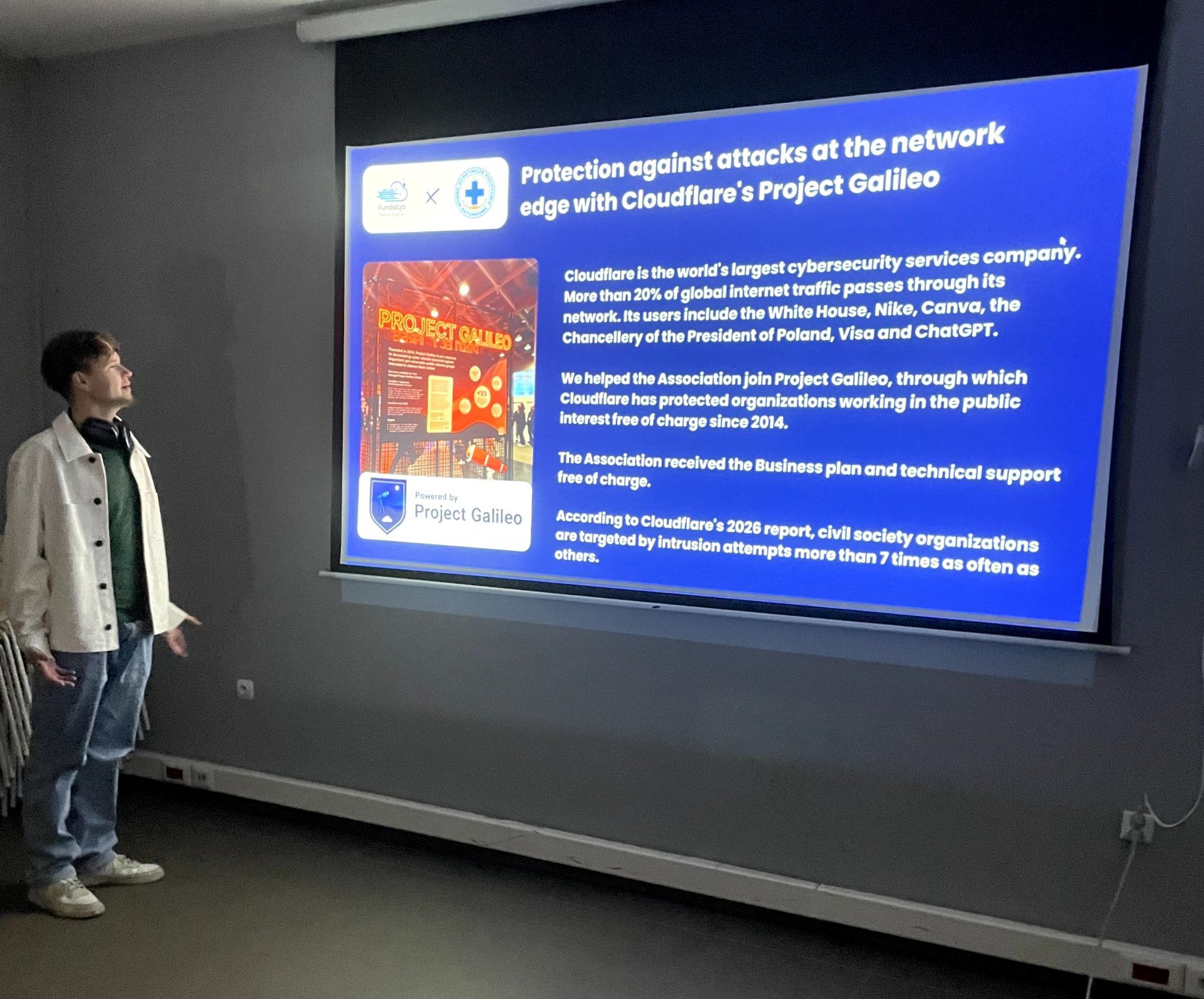
Non-profit organizations are increasingly targeted by cyberattacks, yet they rarely have the budget for professional protection. That is why we helped Śląskie WOPR join Project Galileo, through which Cloudflare has been protecting organizations working in the public interest free of charge since 2014. Cloudflare is one of the world’s largest companies in internet security and performance. The association received the Business plan free of charge, together with technical support.
As a result, all traffic directed to Śląskie WOPR websites passes through several layers of security before it reaches the server:
- proxy and CDN: traffic passes through the Cloudflare network edge, and the server’s real address stays hidden,
- caching: copies of pages are stored close to visitors, which speeds up loading,
- bot filters: bots that scan the internet for vulnerabilities are blocked,
- WAF rules: the web application firewall stops intrusion attempts, such as malicious code injection,
- country blocking: traffic from countries we do not expect visits from, and from which attacks often originate, is rejected,
- DDoS protection: floods of artificial traffic are detected and filtered out, and the website keeps working for regular visitors,
- monitoring and analytics: a real-time view of traffic makes it possible to react before a problem occurs.
Speed: several layers of caching
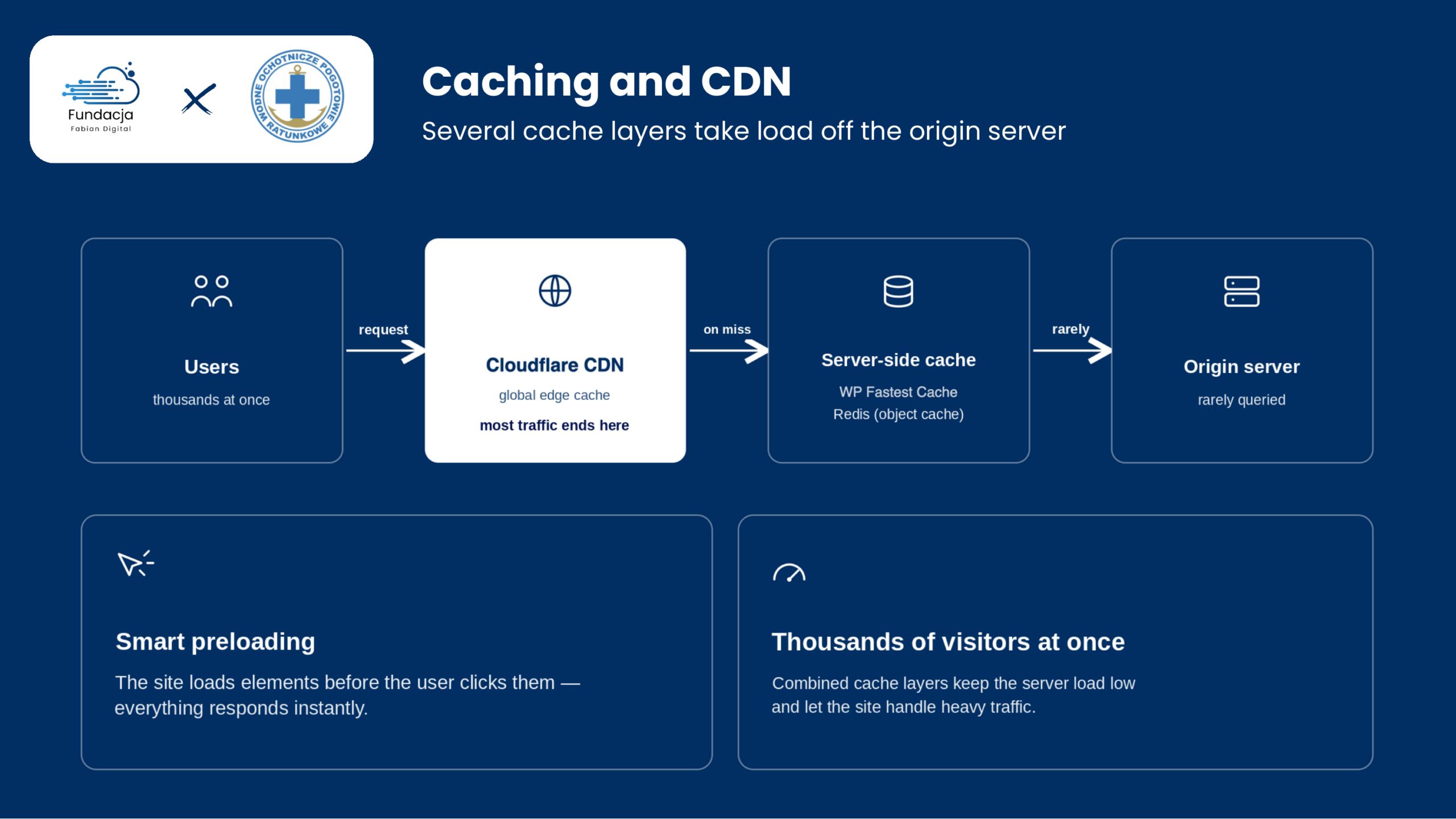
How traffic reaches the Śląskie WOPR websites
Choose who is visiting the website and see which security layers the request passes through, where it gets stopped and where the response comes from.
Internet
Cloudflare network edge
Server
The edge security layers are provided through Project Galileo, in which Cloudflare protects public-interest organizations free of charge. Implementation: Fabian Digital Foundation.
What’s next
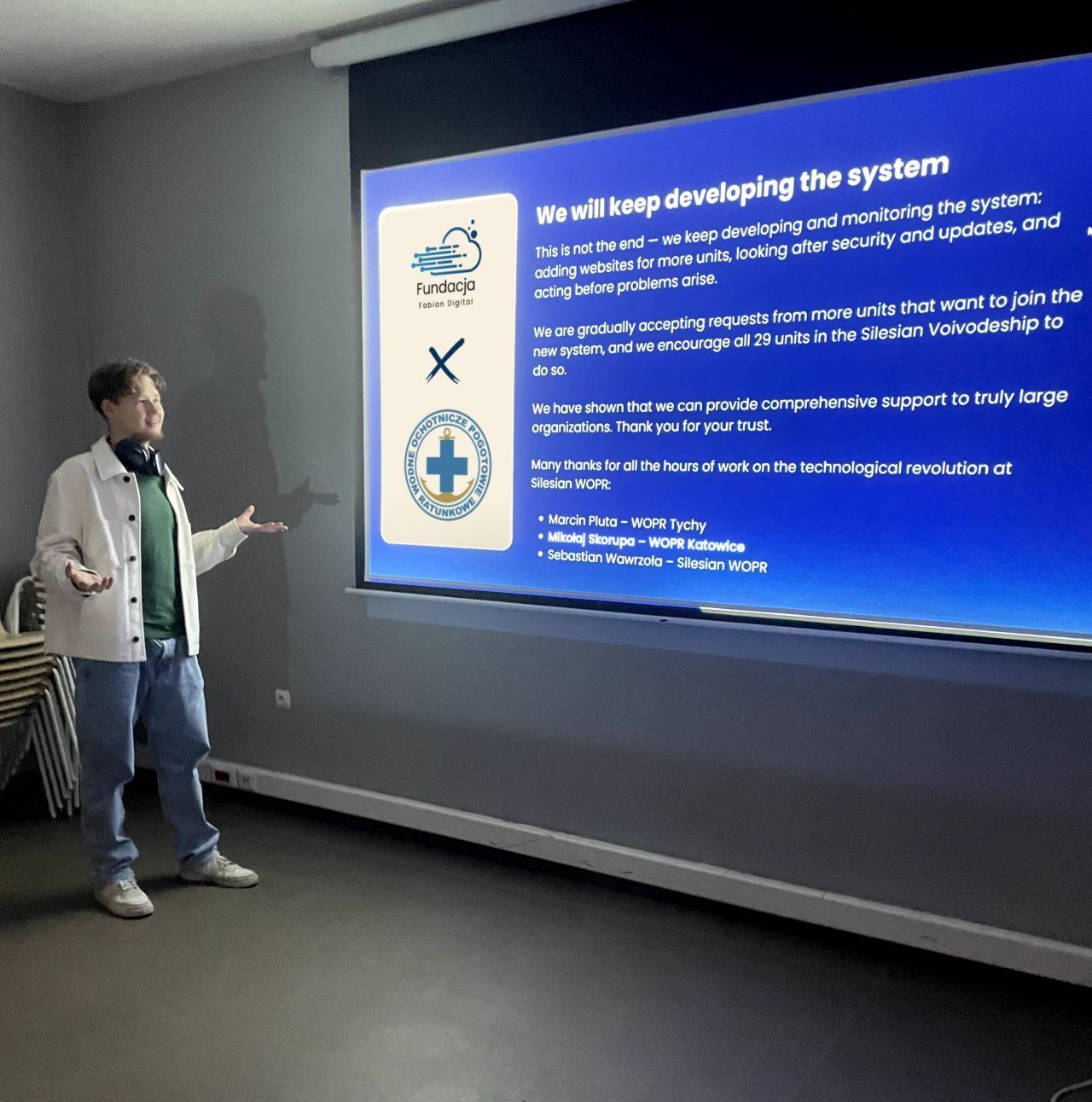
This is not the end. We keep developing and monitoring the system: we add websites for more branches, look after security and updates, and react before problems arise.
We are gradually accepting requests from more branches that want to join the new system, and we encourage all 29 branches operating in the Silesian Voivodeship to do so. Each new branch can join within a few hours, using the ready-made template, plugins and security setup.
We have shown that we can provide comprehensive support to truly large organizations, from organizing domains, through server infrastructure and edge protection, to websites, textbooks and tools for the team. Thank you for your trust.
If your organization faces similar challenges, such as an outdated website, a lack of security or scattered tools, contact us at [email protected]. Through our Online Mission (Misja Online) and Visible Online (Widoczni w Internecie) programs, we support non-governmental organizations in their digital transformation.
Acknowledgements
I would like to sincerely thank the following people for all the hours they spent on the technological transformation of Śląskie WOPR:
- Marcin Pluta — WOPR Tychy,
- Mikołaj Skorupa — WOPR Katowice,
- Sebastian Wawrzoła — Śląskie WOPR.
The system was built single-handedly by Fabian Grabania, President of the Board of the Fabian Digital Foundation.
- Tychy Regional Branch – tychy.slaskiewopr.pl
- Śląskie WOPR – slaskiewopr.pl
- Katowice City Branch – woprkatowice.pl
- Mysłowice Regional Branch
- Siemianowice Śląskie Regional Branch
- Chorzów Regional Branch
- Piekary Śląskie Regional Branch
We are still presenting our project to other branches and agreeing on the details of cooperation.
All branches are welcome!